



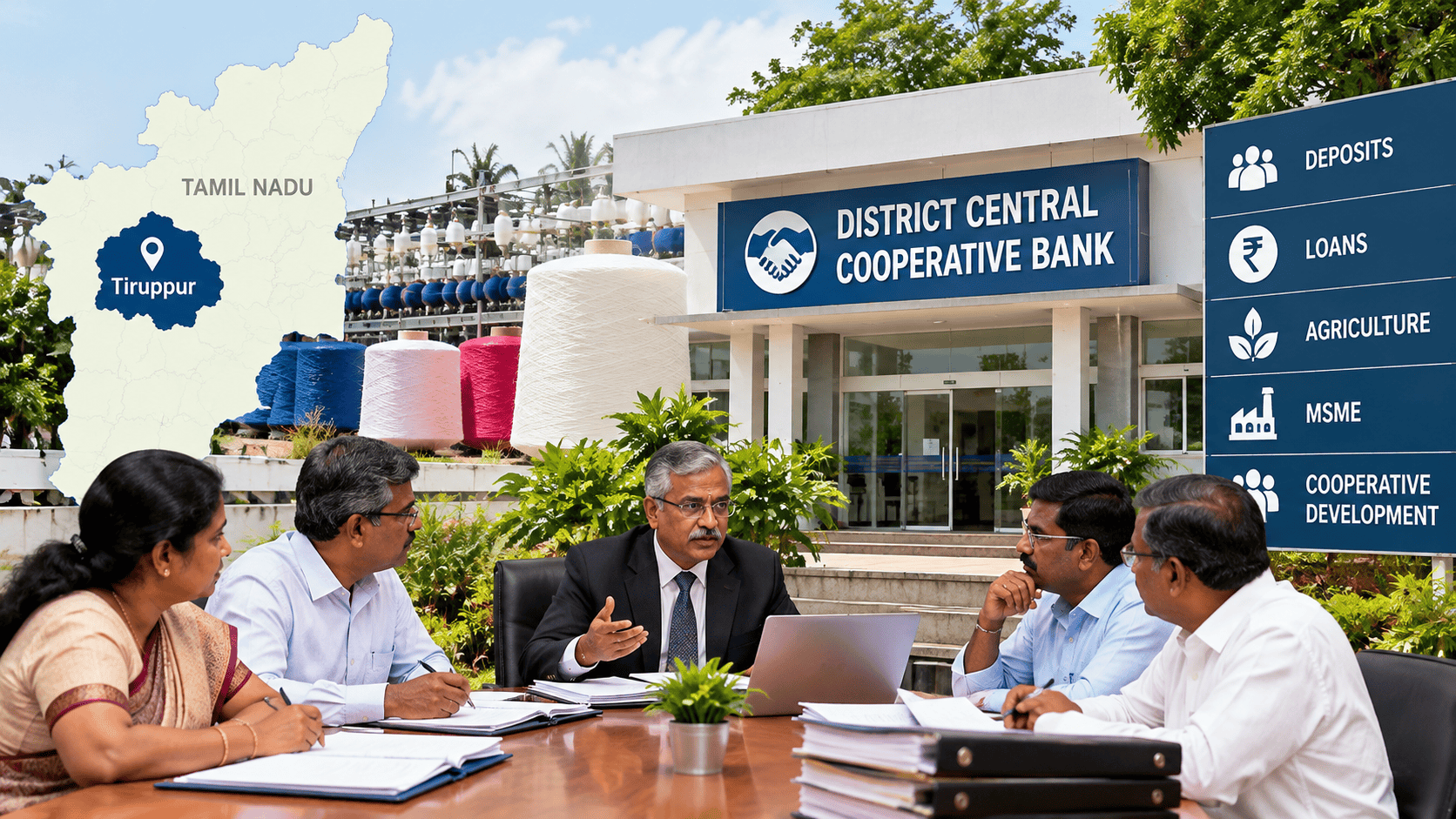
The Tamil Nadu government has constituted a special committee to examine the feasibility of establishing a separate District Central Cooperative Bank (DCCB) in Tiruppur, bringing a long-standing demand for an independent district-level cooperative banking institution back into focus.
According to news reports, Registrar of Cooperative Societies G Latha constituted the committee, chaired by retired IAS officer Jatindra Nath Swain. P Loganathan, Managing Director of Tamil Nadu Urban Cooperative Banks, has been appointed its coordinator. The committee includes senior officials from the existing DCCBs in Coimbatore and Erode, the Tamil Nadu State Apex Cooperative Bank and the cooperative department’s regional offices.
The committee has been asked to assess whether a separate DCCB for Tiruppur can operate on a financially sustainable basis. Its examination will cover the prospects for mobilising deposits and extending loans, along with the potential implications for the existing cooperative banks serving the region.
Tirupur still dependent on neighbouring DCCBs
Tiruppur was carved out as a separate district 17 years ago but its cooperative banking administration continues to depend on institutions headquartered in neighbouring districts. This arrangement reflects the district’s origins, with its territorial areas previously forming part of Coimbatore and Erode.
The demand for a dedicated DCCB has persisted for years. Farmers and other stakeholders have called for a separate institution to address local administrative requirements and improve the coordination of cooperative credit operations. The issue was again highlighted in August 2026, when farmers sought the establishment of a bank headquartered in Tiruppur.
The district’s official cooperative department profile lists 182 Primary Agricultural Cooperative Credit Societies (PACS), underlining the scale of its grassroots cooperative credit network.
Financial viability central to the assessment
The committee has to determine whether Tiruppur can support a separate DCCB through deposit mobilisation and lending, while considering the consequences for the Coimbatore and Erode banks.
These questions will be important in determining the institutional structure of any proposed bank, including how existing cooperative credit operations would be reorganised, if required. The committee’s findings are expected to inform the next steps; its constitution does not, by itself, amount to a decision to establish the bank.
The committee has already held its first meeting, according to the report, with another meeting expected shortly before the submission of its findings.
