



- About Cooperative Sector in Kerala
- Kerala Cooperative Sector Data Box
- Top Cooperative Societies in Kerala
- Kerala State Cooperation Department
- Kerala State Registrar of Cooperative Societies
Kerala Cooperative Sector: India’s Most Deeply Networked Cooperative Economy
Introduction
Kerala is widely regarded as one of India’s strongest cooperative states, where cooperatives are not merely financial institutions but an integral part of everyday economic and social life. From agricultural credit and dairy development to housing, consumer distribution, healthcare, education and women-led enterprises, the cooperative movement has built an extensive grassroots network across the state.
Unlike many states where cooperatives remain confined to agricultural credit, Kerala has successfully diversified the movement into multiple sectors. Cooperative institutions today play a significant role in financial inclusion, rural development, food security, employment generation and local economic governance. The state has also adopted a dedicated cooperative policy and one of the country’s most extensive legal and administrative frameworks for cooperative development.
The movement traces its origins to the early twentieth century and has steadily evolved into one of India’s largest cooperative ecosystems. As per the department of Cooperation, Govt. Of Kerala, the state has more than 23,000 cooperative societies operating under department of cooperation as well as other departments.
Cooperative Data for Kerala
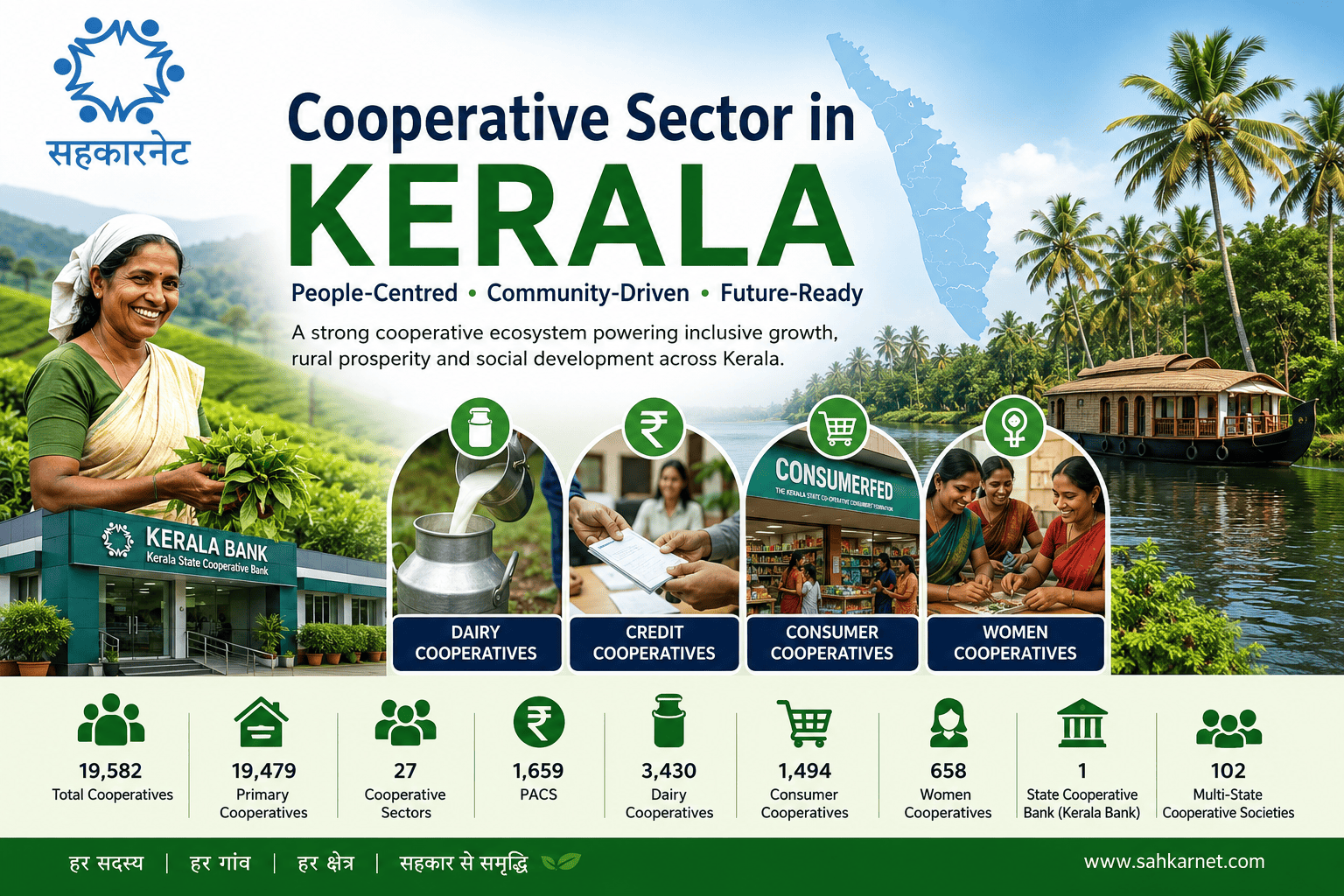
Ministry of Cooperation records 19,582 cooperatives in the state, of which 19,479 are functional. The state also hosts 102 multi state cooperative societies. A detailed statistical profile cooperative sector in Kerala is available here at “Kerala Cooperative Sector Data Box.”
Institutional Structure
The cooperative sector in Kerala is administered primarily through the Department of Cooperation. The department oversees thousands of societies functioning across credit and non-credit sectors through Registrar of Cooperative Societies at the state level and district-level Joint Registrars and Assistant Registrars. About 16256 Co-operative Societies are functioning under the administrative control of Registrar of Co-operative Societies, of which 4148 societies are credit societies. There are 6911 cooperatives regulated by other departments.
The state’s cooperative architecture comprises:
- Kerala State Cooperative Bank (Kerala Bank)
- Primary Agricultural Credit Societies (PACS)
- Urban Cooperative Banks
- Consumer Cooperatives
- Dairy Cooperatives
- Housing Cooperatives
- Marketing Cooperatives
- Labour Cooperatives
- Women Cooperatives
- SC/ST Cooperatives
- Fisheries Cooperatives
- Educational and Hospital Cooperatives
- Processing Cooperatives
- Employee Credit Societies
- Numerous sector-specific cooperative federations.
This diversified structure enables cooperatives to deliver financial as well as social services across urban and rural Kerala. Kerala’s EMS Memorial Cooperative Hospital is considered as a co-operative success story in India.
Legal and Policy Framework
Kerala possesses one of the country’s most developed cooperative governance systems.
The movement primarily operates under the Kerala Cooperative Societies Act, 1969 and the Kerala Cooperative Societies Rules, 1969, supported by periodic amendments and state-specific policy initiatives.
Besides societies registered under the Registrar of Cooperative Societies, several cooperatives function under other functional registrars, including dairy, fisheries and coir sectors, expanding the state’s overall cooperative footprint.
Cooperative Banking and Credit in Kerala
Kerala has one of the most extensive and decentralized cooperative banking networks in India, making it a cornerstone of the state’s financial system and rural economy. The sector is anchored by the Kerala State Co-operative Bank (Kerala Bank), the apex cooperative banking institution, which provides leadership, policy direction, and financial support to the cooperative credit structure.
The cooperative banking system in the state broadly comprises three tiers:
- Apex Level: The Kerala State Co-operative Bank (Kerala Bank) was established through the amalgamation of the former Kerala State Cooperative Bank and all 14 District Cooperative Banks. It functions as a scheduled commercial bank, offering a wide range of modern banking services, including digital banking, RTGS/NEFT, mobile banking, internet banking, and other technology-enabled financial services.
- Long-Term Cooperative Credit Structure: The Kerala State Co-operative Agricultural and Rural Development Bank (KSCARDB) provides long-term credit for agriculture, allied activities, rural infrastructure, housing, and other developmental purposes, complementing the short-term cooperative credit system.
- Primary Level: At the grassroots, the cooperative banking network comprises more than 1,600 Primary Agricultural Credit Societies (PACS) and several licensed Urban Cooperative Banks (UCBs). These institutions play a crucial role in financial inclusion by providing agricultural credit, retail banking services, deposits, microfinance, and other community-based financial services, particularly in rural and semi-urban areas. Primary Agricultural Credit Societies (PACS) constitute the grassroots tier of the short-term cooperative credit structure. They provide:
- Crop loans
- Agricultural investment credit
- Gold loans
- Consumer loans
- Housing finance
- Small business finance
- Deposit mobilisation
- Government benefit distribution
Over the years, many PACS in Kerala have evolved into multi-service rural institutions offering banking, agricultural input supply, public service delivery and local development activities, going well beyond traditional agricultural lending. Their wide presence has made them among the most accessible financial institutions in rural Kerala.
Dairy Cooperatives
Kerala’s dairy cooperative movement forms one of the state’s most successful rural development models.
The dairy network functions through thousands of village-level dairy cooperative societies linked with district milk unions under the three-tier cooperative structure. These societies procure milk from farmers, provide veterinary support, cattle feed, extension services and ensure assured market access.
The dairy cooperative system has significantly contributed to enhancing rural incomes while reducing dependence on private intermediaries. According to the latest official statistics, Kerala has over 3,300 functioning dairy cooperative societies across the state. MILMA (Kerala Co-operative Milk Marketing Federation (KCMMF) is among the top 10 cooperative societies in India.
Consumer Cooperatives and Public Distribution
Kerala’s cooperative consumer network plays a unique role in supporting the state’s public distribution and food security systems.
Consumer cooperatives operate wholesale and retail outlets supplying essential commodities, groceries and household products. During periods of inflation and supply disruptions, these institutions have often supported price stabilisation through government-backed interventions. There are more than 1400 consumer cooperatives in Kerala
The Kerala State Cooperative Consumers’ Federation (Consumerfed) remains a key institution in this ecosystem.
Housing, Labour and Service Cooperatives
Kerala has developed a diversified cooperative ecosystem extending beyond agriculture.
Housing cooperatives facilitate affordable housing finance and residential development.
Labour contract cooperatives generate employment opportunities by executing public works and infrastructure projects.
Hospital cooperatives and educational cooperatives provide community-based healthcare and educational services, while women cooperatives promote entrepreneurship, livelihood generation and financial inclusion.
Specialised cooperatives also serve SC/ST communities, fisheries, coir, marketing, agro-processing and various service sectors, demonstrating the movement’s broad developmental role.
Kerala’s Uralungal Labour Contract Cooperative Society (ULCCS), is one of India’s oldest and most remarkable labour cooperatives, entirely owned and managed by its dedicated member workforce. The society has an annual turnover of more than Rs. 1,400 crores and has an asset of more than Rs. 6600 crores. ULCCS has achieved success in more than 7,500 projects. Know more about ULCCS here. ULCCS is in fact a lessons in Democratic Governance. Along with AMUL, it was recognised as Global Cooperative Cultural Heritage Sites by International Cooperative Alliance (ICA).
Role in Rural Development
The cooperative movement has been instrumental in Kerala’s rural transformation.
Its contributions include:
- Expanding institutional credit
- Supporting agricultural production
- Promoting dairy development
- Strengthening local entrepreneurship
- Enhancing women’s participation in economic activities
- Supporting housing finance
- Delivering consumer goods
- Generating rural employment
Because of their deep community ownership, cooperatives continue to enjoy high public participation and trust across many regions of the state. Their presence complements local self-government institutions and contributes to inclusive economic development.
Digital Transformation and Modernisation
Kerala has increasingly focused on modernising its cooperative institutions through technology adoption, banking reforms and improved governance.
Several cooperative banks and PACS have adopted core banking solutions, digital payment systems and online member services. The consolidation into Kerala Bank has also accelerated efforts toward standardisation, technology integration and operational efficiency.
Simultaneously, the Ministry of Cooperation’s national initiatives on PACS computerisation, diversification and digitalisation are expected to further strengthen Kerala’s cooperative credit ecosystem.
Challenges
Despite its strengths, Kerala’s cooperative movement faces several structural and governance challenges.
Recent years have witnessed financial irregularities in a few cooperative institutions, bringing issues such as governance standards, internal controls, auditing practices and professional management into focus. These incidents have prompted the state government to recommend stronger risk management, improved audit mechanisms, professional directors, standardised software systems and enhanced regulatory oversight. In fact as per a Times of India report more than Rs 1,582 crore worth of financial irregularities have been unearthed in Kerala’s co-operative banking sector between 2015-25 as per Govt data. This clearly indicates the failure of the governance system in institutions that manages the saving and credit needs of millions of citizens.
Other long-term challenges include:
- Improving governance standards
- Strengthening cyber security and digital infrastructure
- Professionalising management
- Enhancing financial sustainability of weaker societies
- Attracting younger members into cooperative leadership
- Expanding business diversification beyond traditional activities
Future Outlook
Kerala’s cooperative sector is well positioned to support the next phase of inclusive economic development.
Growing emphasis on digital banking, diversified PACS, value-added agriculture, dairy expansion, rural entrepreneurship and cooperative-led service delivery offers significant opportunities. National initiatives under the Ministry of Cooperation—including PACS computerisation, new business activities for PACS and digital integration—are expected to complement Kerala’s already extensive cooperative infrastructure.
Going forward, improved governance, technology adoption and greater business diversification will be essential to ensure that Kerala’s cooperative movement remains one of India’s strongest models of community-owned economic development.
Top Cooperative Societies in Kerala
- Cooperative Sector in India
- Kerala Cooperative Sector Data Box
- Top 10 PACS in Kerala
- Top 10 Dairy Cooperatives in Kerala
- Top 10 Fishery Cooperatives in Kerala
- Top 10 Urban Cooperative Banks (UCB) in Kerala
- Top 10 Housing Cooperative Society (HCS) in Kerala
- Top 10 Credit & thrift Society in Kerala
- Top 10 Agro Cooperatives in Kerala
- Top 10 Multipurpose Cooperatives in Kerala
State Cooperation Department
DEPARTMENT OF CO-OPERATION
OFFICE OF THE REGISTRAR OF CO-OPERATIVE SOCIETIES
JAWAHAR SAHAKARANA BHAVAN
DPI JUNCTION, THYCAUD (PO)
THIRUVANANTHAPURAM-695014
KERALA, INDIA
Phone: Office: 0471-2330825, 2331992
E-mail: keralarcs.coop@kerala.gov.in
Url: https://cooperation.kerala.gov.in/
State Registrar of Cooperative Societies
DEPARTMENT OF CO-OPERATION
OFFICE OF THE REGISTRAR OF CO-OPERATIVE SOCIETIES
JAWAHAR SAHAKARANA BHAVAN
DPI JUNCTION, THYCAUD (PO)
THIRUVANANTHAPURAM-695014
KERALA, INDIA
Phone: Office: 0471-2330825, 2331992
E-mail: keralarcs.coop@kerala.gov.in
