



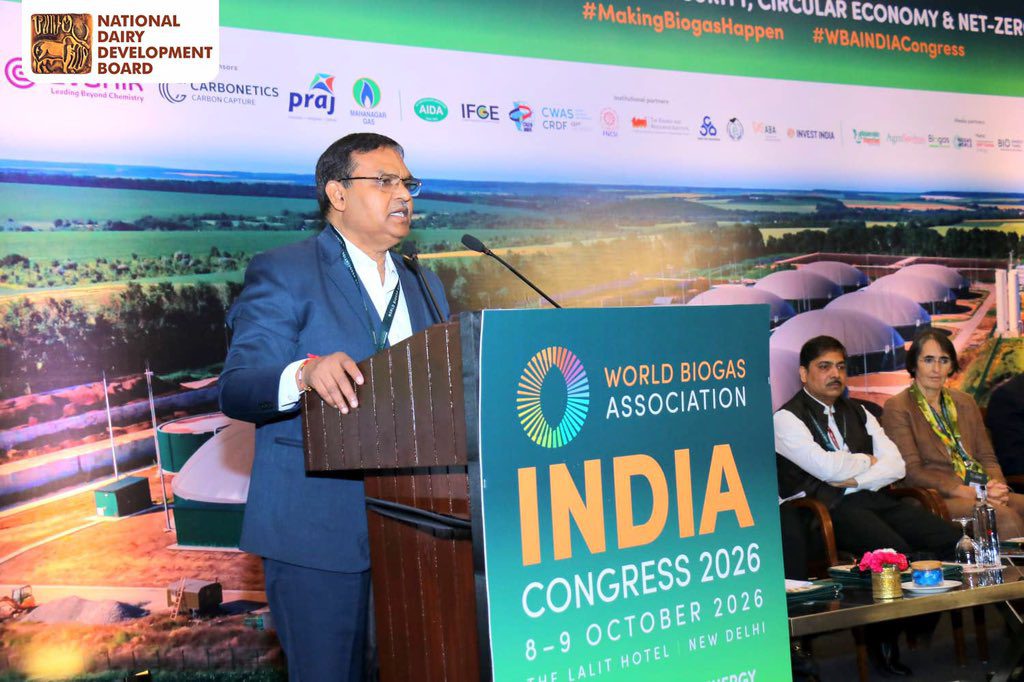
Dr Meenesh Shah, Chairman of the National Dairy Development Board (NDDB), highlighted the role of dairy cooperatives in scaling up biogas and compressed biogas (CBG) production at the World Biogas Association India Congress 2026.
Dr Shah addressed the inaugural plenary session on ‘Biogas & Biomethane as a Strategic Pillar of India’s Energy Security & Net Zero Transition’, which brought together representatives from government, industry and international institutions to discuss the contribution of biogas to India’s energy security and net-zero transition.
Charlotte Morton OBE, Chief Executive Officer of the World Biogas Association, delivered the welcome address. The session was chaired by Shishir Priyadarshini, President of the Chintan Research Foundation. Other speakers included Alok Tripathi, Joint Secretary, Ministry of Petroleum and Natural Gas; Ashish Kumar, CEO of Verbio India; Atul Muley, President of Praj Industries; and Rasmus Alex Wendt, Energy Counsellor at the Embassy of Denmark in India.
NDDB’s focus on dung-based biogas models
Dr Shah highlighted India’s transition from a biogas opportunity towards an integrated biogas ecosystem. He emphasised the potential of biogas, particularly CBG, to strengthen energy security, promote rural prosperity, improve waste management and support agricultural sustainability.
He pointed to the substantial quantities of cattle dung generated by India’s large bovine population and outlined NDDB’s efforts to harness this resource through different biogas models.
These include household and community-based plants, gaushala-based projects, large-scale biogas plants at dairy facilities and CBG production models.
Dr Shah emphasised the pivotal role of dairy cooperatives in aggregating cattle dung and scaling up biogas production, with particular attention to CBG. He also noted that the viability of dung-based biogas projects should be assessed through an integrated value chain covering energy, organic fertilisers and carbon-reduction benefits.
India–Japan partnership targets 1,000 plants
Highlighting the India–Japan partnership to establish 1,000 dung-based CBG plants, Dr Shah said the initiative would combine Japan’s technology and operational expertise with India’s extensive dairy cooperative network and rural implementation capabilities.
The initiative envisages two phases of 500 plants each. It aims to bring together CBG production, organic fertilisers, farmer cooperatives, technology and financing to support the adoption of dung-based biogas solutions.
The partnership places dairy cooperatives at the centre of the proposed implementation framework, drawing on their network and links with farmers across rural India.
Book on India’s biogas ecosystem unveiled
The inaugural plenary also witnessed the unveiling of India’s Biogas Ecosystem: A Landscape Review.
The publication examines India’s biogas ecosystem and contributes to discussions on the development of the country’s biogas and biomethane sector.
The session brought together government officials, industry representatives and international stakeholders to discuss biogas and biomethane as components of India’s energy security and net-zero transition.
Dr Shah’s address focused on the potential of India’s cattle dung resources, NDDB’s work on different biogas models, the role of dairy cooperatives in feedstock aggregation and the proposed India–Japan partnership for establishing dung-based CBG plants. Read about NDDB’s related initiative at दिल्ली में गोबर से बनेगी स्वच्छ ऊर्जा — और साफ होगी यमुना: MCD-NDDB समझौता.
