



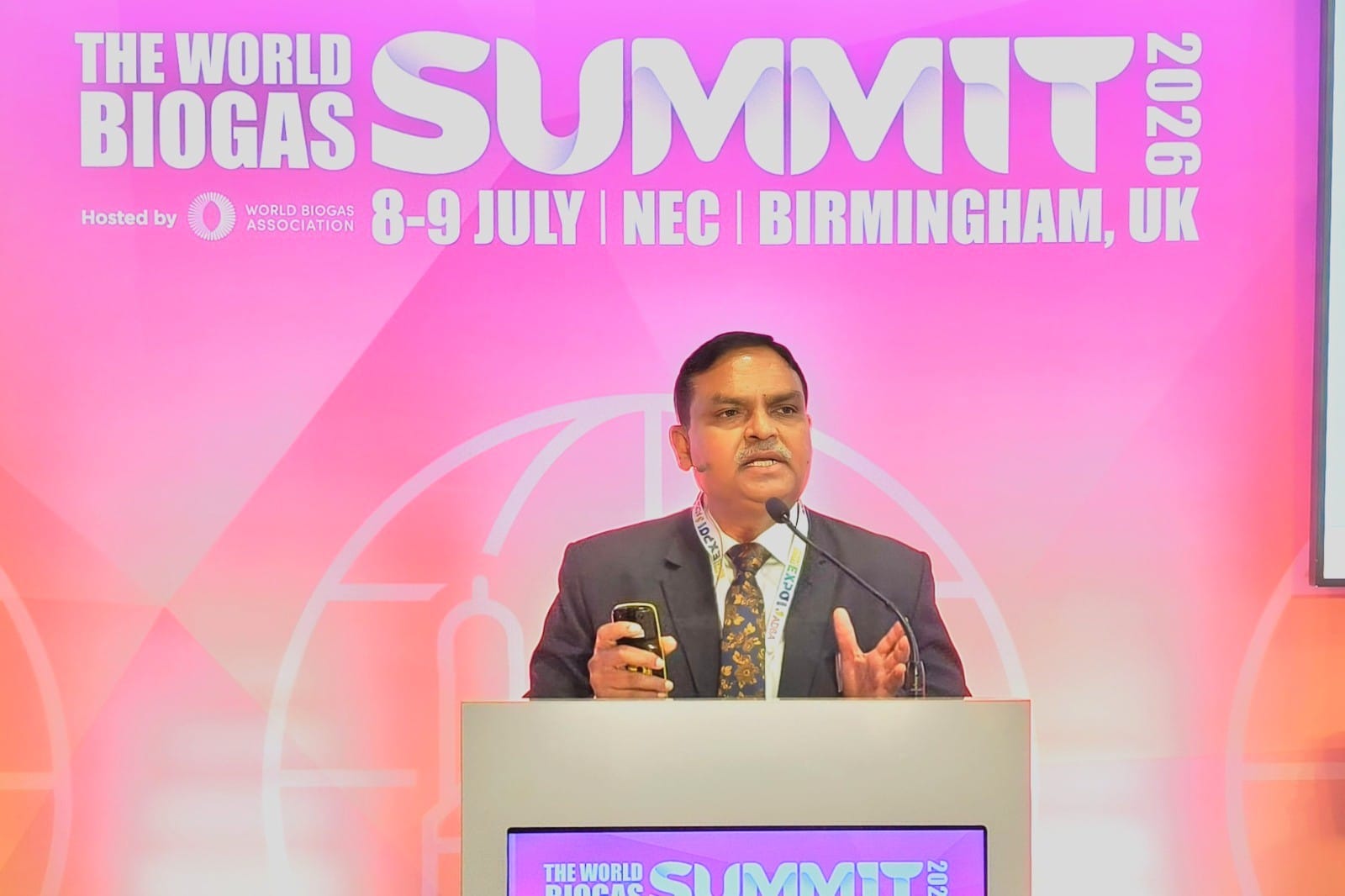
Birmingham (UK), July 8: India’s dairy cooperative sector has emerged as a key driver of the country’s circular bioeconomy, with significant potential to expand biogas, compressed biogas (CBG) and organic fertiliser production while creating new income streams for farmers. This vision was presented by Dr. Meenesh Shah, Chairman of National Dairy Development Board, during the session on Global Biogas Outlook: India, Italy, Ukraine at the World Biogas Expo & Summit 2026 in Birmingham, United Kingdom.
Dairy Cooperatives as Foundation for Scaling Renewable Energy
Addressing an international audience, Dr. Shah explained how India’s extensive dairy cooperative network can serve as the foundation for scaling renewable energy and sustainable manure management. He said the cooperative model not only enables efficient collection and utilisation of cattle dung but also ensures fair value distribution, market access and long-term benefits for rural communities.
India’s Strength
Highlighting India’s strengths, Dr. Shah noted that the country is the world’s largest milk producer, supported by more than 80 million rural dairy households, 302 million bovines and an estimated 1,653 million tonnes of cattle dung generated annually. This resource base is backed by a nationwide cooperative structure comprising 22 state dairy federations, 241 district milk unions, over 2.3 lakh village dairy cooperative societies and around 17 million dairy farmers, creating a strong ecosystem for biogas development.
Manure Management Models at NDDB
The presentation outlined several manure management models being promoted by NDDB, including household biogas plants that provide clean cooking fuel, organic slurry and carbon credit opportunities, as well as community-based and centralised biogas and CBG plants that generate renewable energy, organic fertilisers and additional income through dung procurement.
Dr. Shah also highlighted the India-Japan CBG Initiative, which aims to establish 1,000 compressed biogas and organic fertiliser plants through the cooperative sector. He referred to NDDB’s collaborations with Suzuki Motor Corporation through NDDB Mrida Ltd., Sustain Plus and the Multi-State Manure Cooperative to strengthen the manure value chain and accelerate biogas adoption across the country.
Cattle Manure as a Valuable Economic Resource
Concluding his address, Dr. Shah stressed that cattle manure should be viewed as a valuable economic resource rather than waste. He said India’s dairy cooperative model offers a scalable pathway for renewable energy generation, climate resilience, sustainable agriculture and enhanced farmer incomes, while contributing to global efforts towards a circular bioeconomy.
