



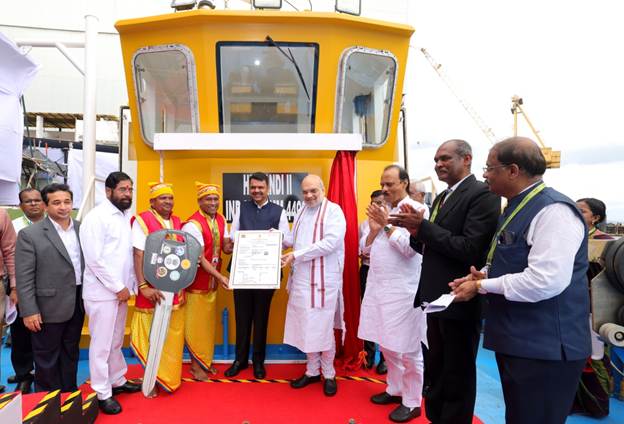
When Union Home and Cooperation Minister Amit Shah inaugurated “Deep Sea Fishing Vessels” under the Pradhan Mantri Matsya Sampada Yojana (PMMSY) at Mazgaon Dock, Mumbai, it marked more than a maritime milestone — it signaled the beginning of a new cooperative-driven phase in India’s blue economy.
A Vision Anchored in Cooperation
The initiative represents a strategic blend of economic modernization and inclusive growth. Under the leadership of Prime Minister Narendra Modi, the government aims to replicate the success of India’s dairy and sugar cooperatives in the fisheries sector.
By transitioning fishermen from wage earners to cooperative shareholders, the model ensures that the value generated from India’s vast marine wealth reaches those who toil at sea.
“The hardworking poor should be the owners of the profit,” Shah emphasized — a statement that captures the essence of this effort. The launch of two trawlers, capable of remaining at sea for up to 25 days and carrying 20 tons of fish each, is the first step in a broader plan to distribute such vessels through cooperatives across coastal states. Fourteen trawlers will be rolled out initially, with more to follow under a joint initiative of the Ministry of Cooperation, the Fisheries Department, and state governments.
Deep-Sea Push for Atmanirbhar Bharat
India’s 11,000-kilometre coastline offers enormous potential for sustainable economic expansion. By empowering local fishing cooperatives, the government is not only enhancing livelihoods but also reinforcing its Atmanirbhar Bharat (self-reliant India) vision. The trawlers are equipped with modern amenities and backed by plans for cooperative-managed processing, chilling, and export facilities — ensuring that value addition remains within the community ecosystem.
The cooperative model aims to transform the fisheries value chain into an integrated enterprise. From catch to processing to export, each step will be organized under cooperative structures, creating employment, improving efficiency, and minimizing exploitation by intermediaries. This inclusive approach also supports the broader goal of human-centric growth — prosperity measured not just by GDP, but by shared community welfare.
Scaling the Blue Economy
India’s fisheries sector has witnessed remarkable progress in recent years. Total fish production has nearly doubled — from 102 lakh tonnes in 2014–15 to 195 lakh tonnes today. Freshwater production has seen a 119% jump, while marine output has risen from 35 lakh tonnes to 48 lakh tonnes. This surge underscores the untapped potential of the sector and the importance of continued modernization.
Through cooperative engagement, the government now aims to build a scalable framework for deep-sea fishing that can support export competitiveness, attract private investment, and generate sustainable incomes along the coast. The Ministry of Cooperation’s focus on multistate export cooperatives will further help Indian fisheries connect to global markets.
Building Prosperity from the Coastline Inward
What makes this initiative stand out is its emphasis on economic equity. As Shah noted, true prosperity is achieved when every family has access to education, nutrition, and self-reliance. Cooperatives — whether in milk, sugar, or fisheries — have historically demonstrated that collective ownership can drive economic and social transformation.
Just as Amul turned India into the world’s largest milk producer and Maharashtra’s cooperative sugar mills enriched its rural landscape, the cooperative fisheries model has the potential to do the same for India’s coastal communities. By institutionalizing collective ownership, the government is creating a resilient system where economic empowerment and national growth go hand in hand.
The Cooperative Current Ahead
The deep-sea fishing initiative is a defining step in aligning India’s blue economy with its cooperative ethos. It integrates modern technology, maritime potential and social inclusion — a combination that promises sustainable, community-led growth.
