



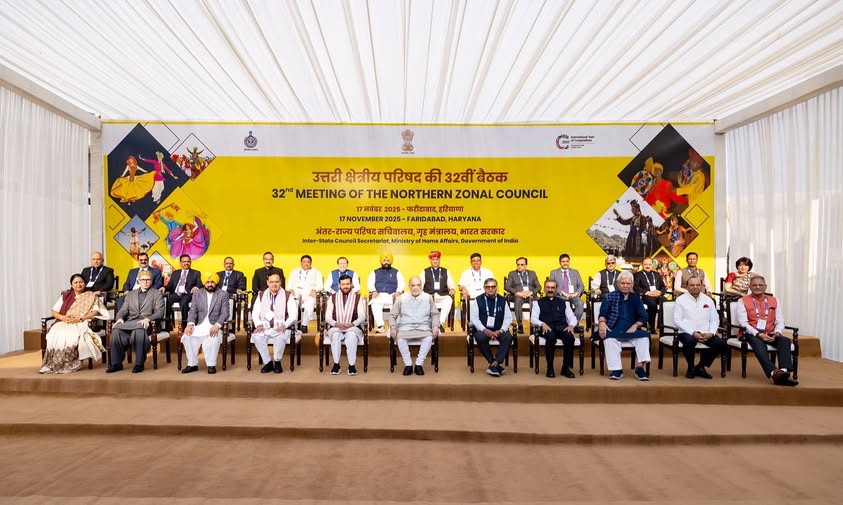
Union Home Minister and Minister of Cooperation Amit Shah underscored the transformative role of India’s cooperative sector in generating employment, boosting rural incomes, and strengthening local economies at the 32nd meeting of the Northern Zonal Council (NZC) held in Faridabad on Tuesday.
Chaired by Shah, the meeting brought together Chief Ministers and senior representatives from Haryana, Punjab, Himachal Pradesh, Rajasthan, Delhi, Jammu & Kashmir, Ladakh, and Chandigarh, along with top officials from the Centre.
Cooperation Positioned as a Pillar of Inclusive Growth
Placing strong emphasis on cooperation, agriculture and fisheries, the Minister said these sectors have become “important means of eradicating poverty and providing employment,” reiterating Prime Minister Narendra Modi’s vision of ‘Sahkar Se Samriddhi’ (Prosperity through Cooperation).
Shah highlighted that sustainable development requires not just GDP growth but widespread economic upliftment, particularly through self-employment and cooperative-led enterprises.
He outlined the Ministry of Cooperation’s ongoing nationwide initiatives, including:
- Computerisation of Primary Agricultural Credit Societies (PACS)
- Setting up of three new national-level cooperative societies
- Establishment of Tribhuvan Sahkari University dedicated to cooperative education and skilling
- A package of 57 initiatives aimed at modernising and professionalising the cooperative ecosystem
According to Shah, these interventions are designed to expand opportunities in farming, allied sectors, rural industries, and local value chains — areas where cooperatives play a foundational role.
Strengthening PACS and Rural Credit Featured Among Key Agenda Items
Among the six national priority discussions, strengthening Primary Agricultural Credit Societies (PACS) featured prominently. The Minister said enhancing PACS infrastructure and digital capabilities is critical for improving last-mile credit delivery, boosting agri-productivity, and creating rural employment.
Other national topics touched upon briefly included urban planning, power supply systems, nutrition under Poshan Abhiyan, school dropout rates, and public hospital participation in the Ayushman Bharat–PMJAY scheme.
Federal Cooperation and Policy Coordination Emphasised
Reaffirming that “strong states create a strong nation,” Shah said Zonal Councils have evolved into action-oriented platforms enabling Centre–state and inter-state coordination. Since 2014, meetings of Zonal Councils and their standing committees have increased 2.5 times, helping resolve over 81% of issues taken up.
The meeting also reviewed:
- State-level initiatives for women and child safety, including fast-track courts
- Water-sharing and water-resource management challenges
- Banking access in remote villages
- Emergency Response Support System (ERSS-112)
- Millet promotion and nutritional diversification
The Council paid tribute to victims of the recent Delhi car blast and Nowgam Police Station explosion, reiterating the Centre’s commitment to combating terrorism.
Cooperative Sector Remains Central to Inclusive, Employment-Led Growth
Shah concluded that India’s path to becoming a developed nation hinges on economic empowerment at the grassroots, where cooperatives act as engines of opportunity, entrepreneurship, and local prosperity.
As the cooperative sector undergoes rapid modernisation through digital reforms, new national institutions, and strengthened PACS networks, the Ministry of Cooperation aims to make cooperation a mainstream contributor to national growth, rural development, and job creation.
