



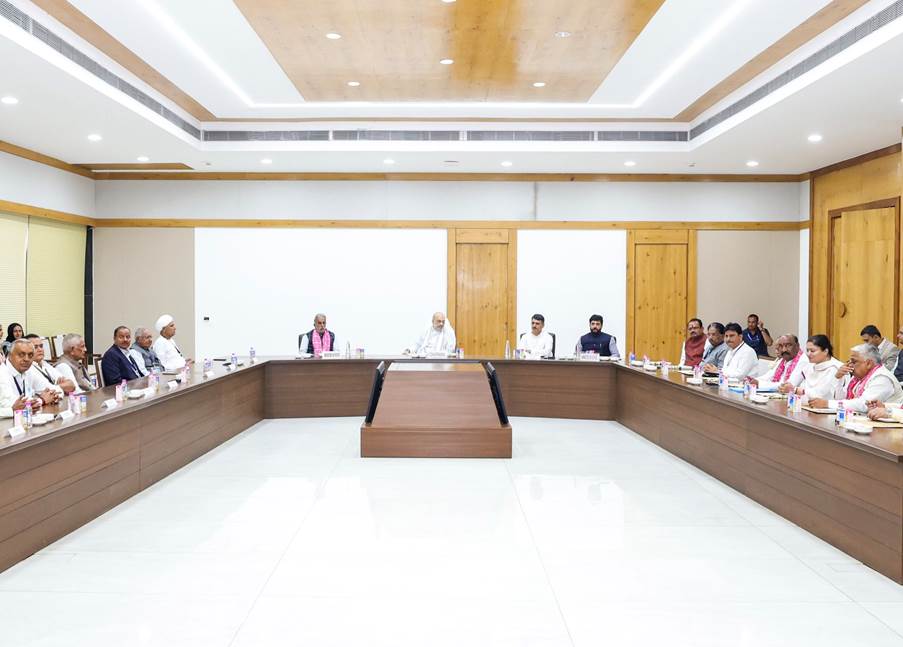
Amit Shah, Union Home and Minister of Cooperation, chaired the meeting of the Parliamentary Consultative Committee of the Ministry of Cooperation on Saturday at Banas Dairy in the Vav–Tharad region of Gujarat to deliberate on the future strategy of India’s cooperative dairy sector and the roadmap for White Revolution 2.0.
The meeting was attended by Ministers of State for Cooperation Krishan Pal Gurjar and Murlidhar Mohol, Members of Parliament who are part of the Parliamentary Consultative Committee, Cooperation Secretary Dr. Ashish Kumar Bhutani and senior officials of the Ministry of Cooperation.
Focus on White Revolution 2.0 and Cooperative-Led Growth
A detailed presentation was made before the Committee on the current status, growth potential and reform priorities of the cooperative dairy sector, with emphasis on circular economy practices, sustainability and long-term institutional strengthening. Read more about White Revolution 2.0 here.
Shah said cooperation remains the backbone of India’s rural economy, playing a central role in enhancing farmers’ incomes, promoting women’s economic participation and strengthening national self-reliance in milk production. He reiterated that dairy cooperatives are a key driver of the government’s vision of ‘Sahakar Se Samriddhi’.
Key Policy Directions Discussed by the Committee
The Parliamentary Consultative Committee discussed several measures to deepen cooperative penetration and improve service delivery at the grassroots. These included linking village-level cooperative societies with cooperative insurance institutions to expand access to insurance services in rural areas.
It was discussed that dairy cooperative societies could act as facilitation points for two-wheeler and four-wheeler insurance, helping rural households access formal financial protection through the cooperative network.
The Committee also discussed encouraging cooperative institutions to invest in other cooperative entities to strengthen capital formation and promote mutual growth within the cooperative ecosystem.
National-Level Institutional Expansion for Dairy Sector
The Committee reviewed the establishment of three national-level Multi-State Cooperative Societies in the dairy sector. Through these, the National Dairy Development Board (NDDB) and the Department of Animal Husbandry and Dairying are implementing White Revolution 2.0.
The programme aims to set up a cooperative society in every panchayat and a functional dairy in every district with adequate milk production, creating a nationwide cooperative dairy infrastructure.
Skill Development and Knowledge Institutions
The Committee was informed that the Tribhuvan Sahkari University in Anand will work alongside dairy technology institutions to roll out academic programmes in Dairy Technology and Management. These B.Sc. and M.Sc. programmes are expected to create a trained workforce capable of replicating successful cooperative models in different parts of the country.
Soil Health and Sustainable Farm Practices
The Parliamentary Consultative Committee also took note of proposals to establish four modern soil testing laboratories in each district to improve scientific soil health assessment. Members emphasized the need to educate farmers on the balanced and timely use of fertilisers such as urea, DAP and micronutrients to preserve soil health and enhance agricultural productivity.
