



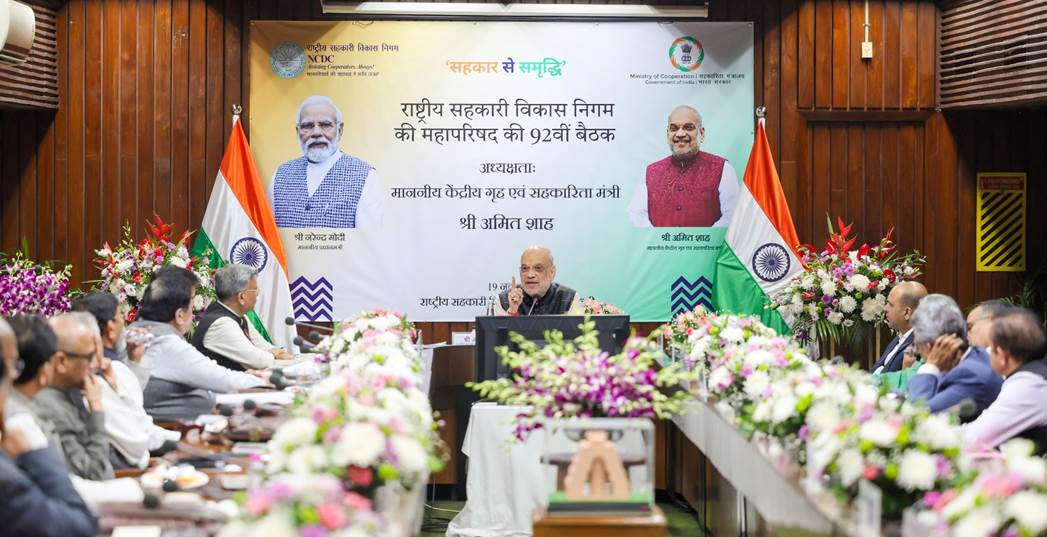
Union Home and Cooperation Minister Amit Shah addressed the 92nd General Council meeting of the National Cooperative Development Corporation (NCDC) on Tuesday, emphasizing the corporation’s expanding role in accelerating cooperative-led growth across India.
Shah said the cooperative sector has witnessed “unprecedented progress” since the formation of the Ministry of Cooperation under the leadership of Prime Minister Narendra Modi. He noted that NCDC has become a key institution in empowering farmers, rural households, fishers, small producers, and micro-entrepreneurs.
NCDC Disbursements Quadruple in Four Years
According to the Minister, NCDC’s total disbursements rose from ₹24,700 crore in 2020–21 to ₹95,200 crore in 2024–25, reflecting rapid expansion in financial support for cooperatives. Over the same period, NCDC maintained a CAGR of over 40%, reported zero net NPAs, and posted its highest-ever net profit of ₹807 crore, strengthening its financial reputation.
Shah added that NCDC’s interventions in dairy, food processing, textiles, and marketing through DCCBs, state cooperative banks, and state marketing federations have helped expand financial inclusion and productivity.
Support for PACS, Organic Farming, and Fisheries
The Minister said efforts to develop PACS as Farmer Producer Organizations (FPOs) are ensuring fair returns to farmers and promoting community-focused growth.
He highlighted major initiatives of multi-state cooperatives such as NCEL, BBSSL, and NCOL, which are working to expand organic production and boost agricultural exports.
In the fisheries sector, NCDC has helped form and strengthen 1,070 Fisheries Farmer Producer Organizations (FFPOs), with work underway to support another 2,348 FFPOs under the Pradhan Mantri Matsya Kisan Samriddhi Yojana. Funding for deep-sea fishing trawlers in Maharashtra and Gujarat, Shah said, has strengthened the blue economy and improved livelihoods—especially for women in fishing communities.
Boost to Sugar, Dairy, and Circular Economy
The Minister stressed the need for a stronger circular economy in the sugar and dairy sectors. Following a government grant of ₹1,000 crore for upgrading cooperative sugar mills, NCDC has disbursed ₹10,005 crore to 56 mills for ethanol plants, co-generation, and working capital, providing alternative income streams and easier credit access.
New Cooperative Initiatives and Regional Expansion
Shah announced progress on the cooperative-based “Bharat Taxi” ride-hailing service, with a new multi-state cooperative already registered and work underway on driver enrollment and technology.
To expand cooperative outreach, NCDC has opened a regional office in Vijayawada and sub-offices across Jammu & Kashmir, Ladakh, Sikkim, Manipur, Mizoram, Tripura, Arunachal Pradesh, Meghalaya, and Nagaland, improving access in remote areas.
He also informed that against the government’s grant of ₹2,000 crore approved in July 2025, NCDC has mobilized ₹20,000 crore to provide concessional long-term and working capital support for dairy, livestock, fisheries, sugar, textiles, food processing, warehousing, cold storage, agriculture, and women’s cooperatives.
Youth Engagement and Technological Support
Under the Cooperative Intern Programme, selected young professionals are offering technical and managerial assistance to cooperatives. NCDC has also extended support to Sahakar Sarathi, an umbrella platform that will deliver technology services to urban and rural cooperative banks.
About the General Council
NCDC’s General Council consists of 51 members, including officials from central ministries, state governments, major cooperative bodies, and NITI Aayog. The council serves as the apex policy-making body for cooperative financing across agriculture, rural development, and allied sectors.
