



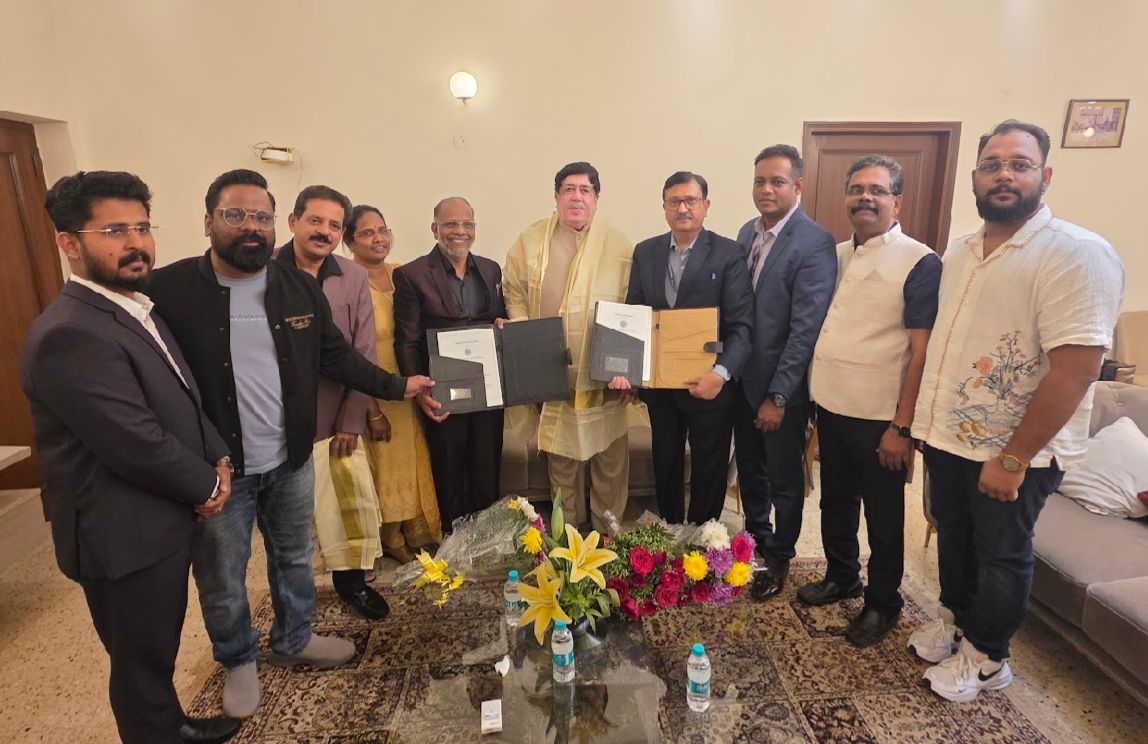
The National Cooperative Union of India (NCUI) has signed a Memorandum of Understanding (MoU) with the Kairali Agriculture Multi-State Cooperative Society (MSCS) of Kerala to advance climate-smart agriculture and provide farmers with new income streams via carbon credits.
The MoU was signed at NCUI’s headquarters in New Delhi in presence of Shri Dileep Sanghani, President of NCUI; Dr. Sudhir Mahajan, Chief Executive of NCUI; Shri K. V. Asokan, Chairman of Kairali MSCS; Latheesh V.K., Project Head for Kairali’s Carbon Credit Project; Shri Pradeep Kumar, CEO; and other board members from Kairali.
Key Objectives of the MoU
Scaling Carbon-Smart Practices:
The partnership will promote sustainable agricultural methods like agroforestry, better manure management, afforestation, reduced biomass burning, and other climate-resilient practices.
Carbon Credit Generation:
Kairali MSCS already runs a Carbon Credit Project, through which it quantifies greenhouse gas (GHG) sequestration on participating farms. Verified credits under global standards like Gold Standard or VERRA can be generated and traded.
Farmer Income Enhancement:
Farmers who adopt these low-carbon practices are expected to receive cash incentives by monetizing the carbon they sequester in their soils.
Digital Monitoring & Participation:
The MoU highlights the use of Kairali’s AGRONET mobile application, which helps with real-time monitoring of practices, farmer enrollment, and transparent tracking of carbon credits.
Capacity Building & Awareness:
NCUI and Kairali aim to run joint training programs for farmers to build awareness of carbon finance, sustainable farming, and the mechanisms of the carbon credit market.
Green Innovation:
The collaboration also plans to support innovative sustainability projects, including microalgae-based “Liquid Tree” systems for urban air purification and black soldier fly larvae units for circular bio-waste management.
Why This Partnership Is Significant
- Cooperative-Led Climate Action: The MoU underscores the role of cooperatives in driving climate mitigation at the grassroots. As Sanghani noted, this agreement leverages the cooperative structure to scale carbon-smart farming across regions.
- Economic Incentives for Farmers: By linking farming practices to carbon markets, farmers gain an additional revenue stream while contributing to climate goals.
- Scalability & Replication: Through NCUI’s nationwide cooperative network, the model has the potential to be replicated beyond Kerala and Tamil Nadu, opening avenues for cross-state and cross-border cooperation.
- Alignment with National Goals: The initiative aligns with India’s broader climate objectives, including net-zero aspirations, by tapping into the agricultural sector’s mitigation potential.
Challenges and Considerations
- Measurement and Verification: Generating carbon credits requires rigorous GHG accounting, monitoring, reporting, and verification, which can be resource-intensive.
- Market Uncertainties: The value of carbon credits depends on demand in voluntary or regulated markets. Prices and buyer commitment may vary.
- Farmer Adoption: Widespread adoption of sustainable practices depends on farmer awareness, trust, and capacity building.
- Regulatory & Policy Support: Success may require policy alignment, including cooperation with national climate frameworks, green finance mechanisms, and possibly regulation or incentives for carbon farming.
If implemented effectively, the NCUI–Kairali MoU could serve as a blueprint for cooperative-driven, climate-smart agriculture. By combining NCUI’s cooperative reach with Kairali’s technical model and digital tools, this partnership could unlock scalable carbon finance for farmers — turning sustainability into a tangible economic opportunity.
