



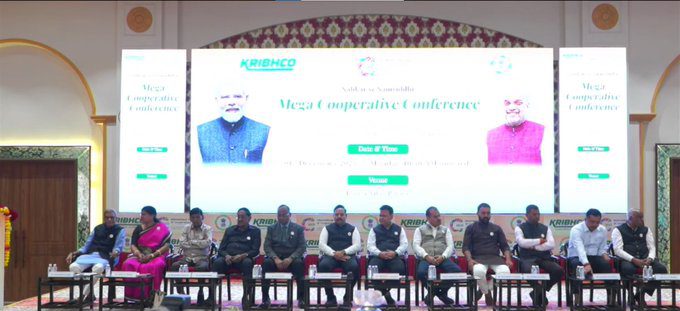
Rajkot, Gujarat — On 1 December 2025, KRIBHCO hosted a high-profile Mega Cooperative Conference in Rajkot, bringing together cooperative leaders, government representatives and stakeholders from across India. The event, held at Ratna Villas Palace, focused on the theme “PACS as Multi-Purpose Hubs: Diversifying Services for Rural Economic Resilience.”
The conference aligns with the national cooperative movement’s renewed momentum this year, as 2025 is being observed as the International Year of Cooperatives (IYC 2025). The IYC, emphasised by KRIBHCO as a national priority, aims to promote inclusivity, innovation, and prosperity through cooperative values.
Ministry of Cooperation lauds KRIBHCO’s leadership
The gathering was graced by Rabindra Kumar Agarwal (IAS), Additional Secretary & CRCS (Central Registrar of Cooperative Societies), Ministry of Cooperation, Government of India. In his address, he appreciated KRIBHCO’s leadership and reiterated the significance of 2025 being designated as the International Year of Cooperatives, highlighting the ongoing nationwide push to strengthen cooperative institutions.
KRIBHCO leadership underscores farmer-centric cooperative vision
Senior KRIBHCO leaders addressed the delegates with reaffirmed commitment to farmer welfare and cooperative values:
- V. Sudhakar Chowdary, Chairman of KRIBHCO, said the cooperative society and similar organisations operate with the vision of Narendra Modi and Amit Shah — “to ensure that farmers receive the true value of their hard work without any middleman.”
- Chandra Pal Singh, Vice-Chairman of KRIBHCO, explained that such conferences help bolster cooperative societies and raise awareness among farmers and cooperators about new government schemes, further propelling the “सहकारी आंदोलन.”
Their remarks underscored the cooperative philosophy that lies at the heart of KRIBHCO’s work — to empower farmers by reducing intermediaries and strengthening grassroots institutions.
Focus on PACS as Multi-Purpose Hubs
A central agenda of the conference was to reimagine Primary Agricultural Credit Societies (PACS) — traditionally credit cooperatives — as multi-purpose hubs capable of delivering diverse services to rural communities.
By broadening the mandate of PACS, KRIBHCO and stakeholders believe these institutions can:
- Facilitate rural financial linkages and credit delivery
- Provide supply of agricultural inputs, including fertilizers, seeds and bio-fertilizers
- Act as distribution points for agriculture-related services and government schemes
- Play a role in rural economic resilience and upliftment, in line with the national slogan “सहकार से समृद्धि.”
The strategy reflects a broader shift in cooperative policy and implementation, aiming to use PACS as instruments of rural development beyond just credit disbursement.
KRIBHCO’s broader cooperative performance and outlook
KRIBHCO, established in 1980, is a national-level multi-state cooperative society engaged in the production and distribution of fertilizers, seeds, bio-fertilizers and other agricultural inputs.
In its 45th Annual General Meeting held in September 2025, KRIBHCO reported a pre-tax profit of ₹692.74 crore for FY 2024–25 and declared a 20 % dividend for all member societies.
With its expansive production capacity, extensive membership base, and diversified offerings, KRIBHCO is positioning itself as a key driver of cooperative-led agricultural growth and rural prosperity in India. Earlier, KRIBHCO, IPL & CIL signed a 5-Year Deal with Saudi’s Ma’aden to import DAP
Significance amid IYC 2025 and cooperative resurgence
With 2025 designated as the International Year of Cooperatives globally and backed by the Government of India’s cooperative push, the Rajkot conference consolidates KRIBHCO’s commitment to strengthening cooperative institutions. Industry experts believe that transforming PACS into multi-service hubs can significantly enhance rural resilience, agricultural efficiency, and farmer incomes.
By bringing together government representatives, cooperative leaders, and grassroots stakeholders, this conference may serve as a pivotal milestone in redefining the role of cooperatives in India’s agrarian economy — from input suppliers to comprehensive rural service providers.
