



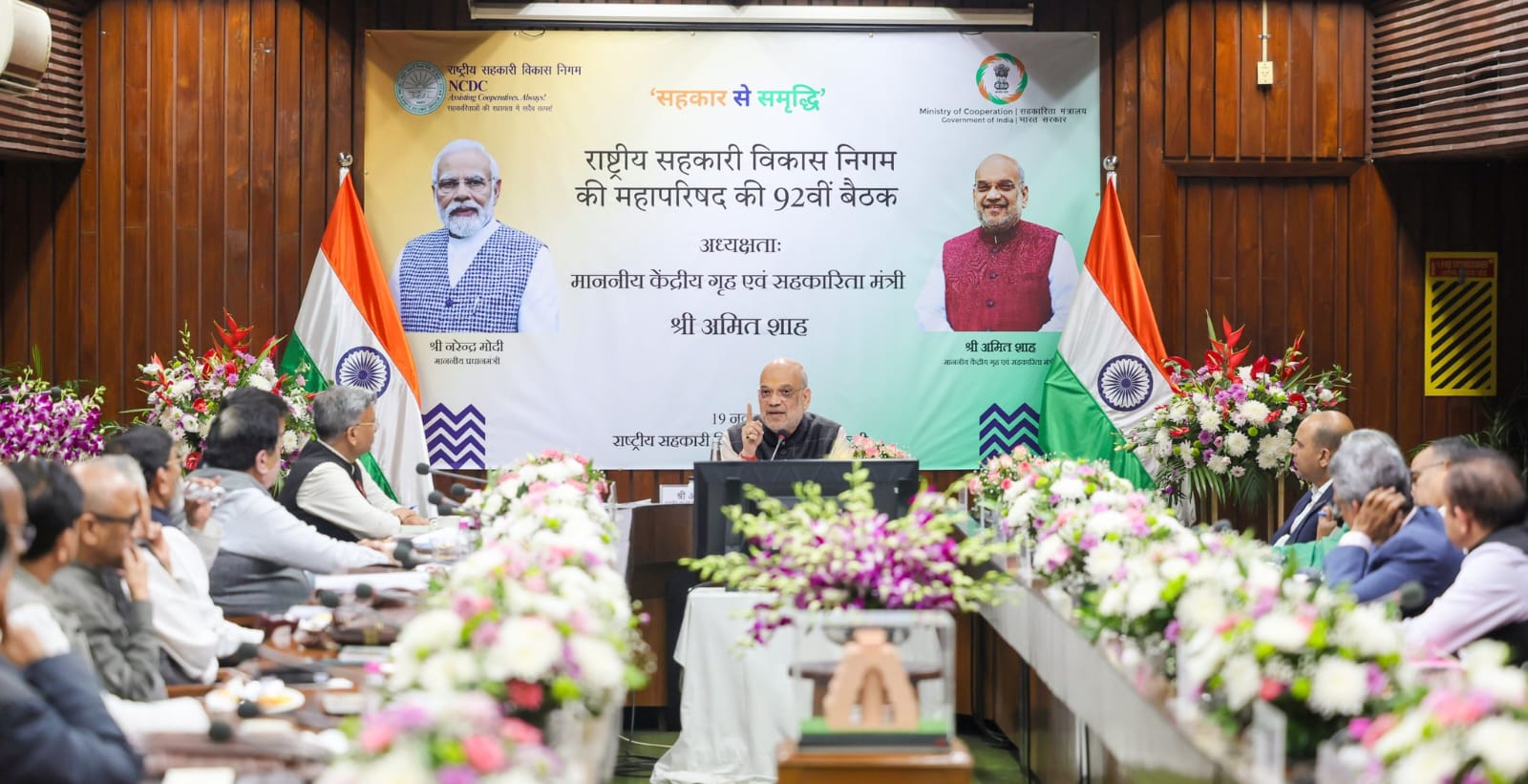
Union Home and Cooperation Minister Amit Shah on Wednesday said that the National Cooperative Development Corporation (NCDC) has emerged as a central force in strengthening India’s cooperative ecosystem. Speaking at its 92nd General Council Meeting in New Delhi, Shah noted that NCDC’s total disbursement has grown nearly four times in four years — from ₹24,700 crore in FY 2020–21 to ₹95,200 crore in FY 2024–25.
Shah attributed this growth to the government’s renewed push for cooperative-led development since the formation of the Ministry of Cooperation in 2021. According to him, NCDC has set “new benchmarks in financial inclusion, governance, and institutional efficiency,” supported by a CAGR exceeding 40%, zero net NPA, and a record net profit of ₹807 crore.
Push for Circular Economy in Sugar and Dairy Sectors
A major focus of Shah’s remarks was the need to build a circular economy in the sugar and dairy industries, enabling value addition and alternative revenue for farmers.
Under a ₹1,000 crore modernisation initiative for cooperative sugar mills, NCDC has already disbursed ₹10,005 crore to 56 mills for ethanol plants, cogeneration units, and working capital, helping these units reduce dependence on traditional sugar revenues.
Shah said these investments align with India’s transition towards cleaner fuels, enhanced rural income, and reduced market volatility for millers and farmers.
Strengthening Fisheries and the Blue Economy
NCDC has also expanded its role in fisheries through the Pradhan Mantri Matsya Kisan Samriddhi Sah-Yojana.
- 1,070 Fisher Farmer Producer Organizations (FFPOs) have been strengthened.
- Work is in progress on 2,348 additional FFPOs.
Financial support for deep-sea fishing trawlers in Gujarat and Maharashtra has “economically empowered coastal communities, especially women,” Shah said, highlighting the corporation’s role in India’s emerging Blue Economy.
₹20,000 Crore Allocation for Dairy, Livestock & Women Cooperatives
Shah announced that NCDC will mobilize ₹20,000 crore in long-term and working-capital loans at concessional rates for:
- Dairy and livestock cooperatives
- Fisheries and sugar cooperatives
- Women-led producer groups
- Storage, cold chains, food processing, and textiles
The funding follows a central government approval of a ₹2,000 crore grant-in-aid earlier this year.
Launch of India’s First Cooperative-Based Ride-Hailing Service
In a significant innovation push, NCDC is leading efforts to develop “Bharat Taxi”, India’s first cooperative ride-hailing platform. A new multi-state cooperative society has already been registered, with driver enrolment and technology integration underway.
Shah said the initiative will give drivers “greater autonomy and earnings,” positioning cooperatives as an alternative model in the mobility sector.
Expanding National Footprint Through Regional Offices
NCDC has rapidly expanded its presence in underserved regions, opening:
- A regional office in Vijayawada
- Sub-offices in Jammu & Kashmir, Ladakh, and the Northeast, including Sikkim, Manipur, Mizoram, Tripura, Arunachal Pradesh, Meghalaya, and Nagaland
This expansion is expected to improve access to cooperative financing and strengthen last-mile visibility.
Cooperative Intern Programme to Boost Youth Engagement
Shah also highlighted NCDC’s Cooperative Intern programme, which deploys trained youth to support cooperative societies with technical, managerial, and digital solutions.
Governance and Policy Oversight
The General Council, comprising 51 members from central ministries, state governments, NITI Aayog and national cooperative federations, is responsible for charting NCDC’s financial strategy and sectoral interventions.
Critical Outlook: Balancing Growth with Governance
While NCDC’s growth story is strong, experts advise that expanded lending — particularly to sugar mills for working capital — must be accompanied by stronger governance and risk evaluation to ensure long-term sustainability.
Conclusion
With multi-sector funding, regional expansion, and new cooperative models like Bharat Taxi, NCDC is increasingly positioned as a central pillar in India’s cooperative-driven economic strategy. The focus on circular economy, women’s empowerment, and youth participation signals a broadening role for cooperatives in achieving rural prosperity and self-reliance.
