



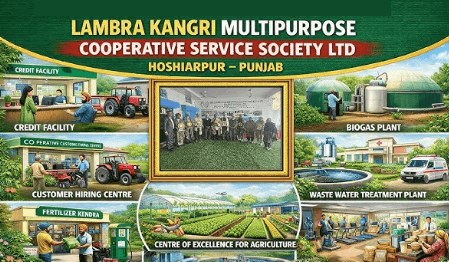
Hoshiarpur, Punjab — At the heart of four villages in Hoshiarpur District — Lambra, Beron Kangri, Dudiana Kalan and Baggewal — a rural cooperative founded more than a century ago stands as a testament to the enduring potential of grassroots institutions in driving inclusive development.
The Lambra Kangri Multipurpose Cooperative Service Society Ltd., originally registered on 27 July 1920 with just 11 members, has grown over 102 years into a vibrant multipurpose cooperative with a membership base of 1,877 adult members, serving a population of 3,724 across 777 households.
Under the stewardship of Jaswinder Singh Saini, Secretary and Project Manager, the Society has diversified its activities beyond traditional credit and agriculture support to include renewable energy, health, education, environmental sustainability and social empowerment.
Recognition and Awards
In 2023, the Society was honoured with the Best Primary Agriculture Cooperative Society Award at the Regional Awards for Cooperative Excellence and Merit organized by the National Cooperative Development Corporation (NCDC) — a recognition of its exemplary performance among Punjab’s Primary Agricultural Credit Societies (PACS).
The accolades continued in 2025 when, on the occasion of NABARD’s 44th foundation day, the Society received a best performance award for its multifaceted services. The honour was conferred to Jaswinder Singh Saini by Punjab’s Finance Minister Harpal Singh Cheema, who highlighted the potential of such grassroots cooperatives to drive inclusive rural development.
From LPG to Piped Biogas: Sustainable Energy Solutions
A signature achievement of the Society is its community biogas initiative, launched in 2016, which enabled villagers to shift from costly liquefied petroleum gas (LPG) cylinders to piped biogas for cooking and other domestic uses.
The centralised biogas plant, with a capacity to produce around 100 m³ of biogas per day, collects cattle dung from households, processes it through a biodigester, and supplies the fuel through a piped network to homes and the Government Senior Secondary School in Lambra, where it is used to prepare mid-day meals for students.
This initiative has delivered measurable benefits: villagers report monthly energy costs of just ₹150–₹200, compared with much higher LPG expenses, and the bio-digested slurry produced in the process serves as a natural fertiliser for local farms, further boosting soil health and agricultural productivity.
Expanding Impact: Innovations and Infrastructure
Beyond energy, the Cooperative has embraced multiple initiatives that highlights its multipurpose character:
- Environmental stewardship — The Society has implemented greywater treatment using rice husk ash, providing a low-cost, natural solution for wastewater management and reuse in irrigation, reducing pollution while generating revenue.
- Agricultural empowerment — Plans are underway for a solar-powered crop processing unit that will host flour mills, rice shellers, oil expellers and masala grinders, allowing farmers to process crops locally at affordable rates.
- Centre of Excellence for Agriculture — Recently launched to provide technical assistance, promote water-efficient farming techniques and connect farmers directly with experts, this centre aims to lower input costs and increase farm incomes through innovation adoption.
- Social services — The Society’s portfolio now includes health camps, ambulance services, physiotherapy support, computer training for girls, free stationery for students, and a Pradhan Mantri Bhartiya Janaushadhi Kendra, enhancing access to affordable medicines.
A Cooperative Model for the Future
From its humble beginnings to its current role as a driver of sustainable rural development, the Lambra Kangri Multipurpose Cooperative Service Society Ltd. embodies the cooperative ethos of collective effort for common good. Through innovation, diversified services and community participation, it has carved a replicable model for other village-level cooperatives seeking to contribute to India’s rural advancement.
As policymakers and cooperative leaders look to strengthen the cooperative movement across Punjab and beyond, the Lambra Kangri story highlights the transformative potential of well-governed, community-focused cooperatives in improving livelihoods, promoting sustainability and fostering inclusive growth.
