



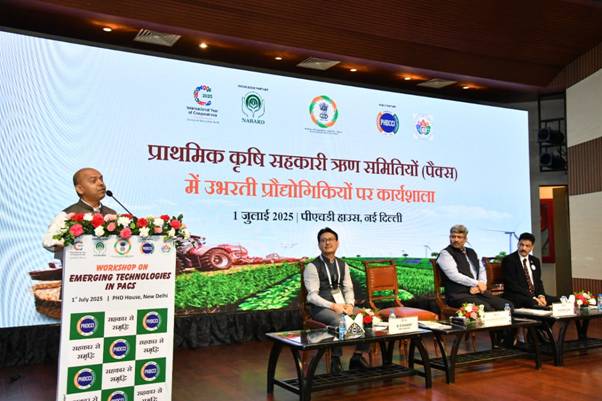
A national workshop focused on the integration of emerging technologies in Primary Agricultural Credit Societies (PACS) was held today at PHD House in the capital. Organised in collaboration with PHDCCI, the event brought together key stakeholders from across the cooperative ecosystem, including officials from NABARD, NCDC, IFFCO, KRIBHCO, and other cooperative institutions.
The inaugural session was addressed by the Secretary, Ministry of Cooperation, Dr. Ashish Kumar Bhutani, who highlighted the growing relevance of PACS in India’s rural credit structure. The workshop was attended by 122 PACS representatives from 12 states, along with senior officials from central and state governments and various cooperative bodies.
Focus on Digitisation, Transparency, and Capacity Building
Dr. Bhutani emphasised the government’s ongoing efforts to modernise PACS through technology adoption, capacity enhancement, and policy reforms. He noted that while cooperative institutions account for around 15% of short-term agricultural lending, PACS alone have seen a 42% increase in beneficiaries, underlining their role in serving small and marginal farmers.
He also drew attention to the structure of India’s cooperative banking system, pointing out that of the nearly 2,000 banking licenses in the country, approximately 1,900 belong to cooperative institutions. Despite this presence, many rural cooperative credit structures remain technologically outdated, limiting the services they can offer.
Key Reforms and Initiatives
The Secretary outlined three major initiatives taken by the Ministry of Cooperation since its formation in July 2021:
- Model Bye-Laws for PACS – Aimed at enabling PACS to diversify beyond agricultural credit into 26 different types of economic activities, encouraging financial self-sufficiency.
- National Database of Cooperatives – Designed to help identify service gaps and streamline development planning at both state and central levels.
- PACS Computerisation Scheme – With ₹3,000 crore already invested, the Ministry now aims to computerise 80,000 PACS and integrate them with central government schemes to enhance transparency and operational efficiency.
Dr. Bhutani likened the potential impact of PACS digitisation to the transformation witnessed in Indian Railways’ ticketing system, suggesting that technology could make PACS both transparent and self-sustaining.
Leveraging Technology for Rural Services
Speaking on the potential of PACS to become multi-service centres, Dr. Bhutani said that these institutions could evolve into “One Stop Shops” for delivering a variety of rural services, including weather forecasts, disaster alerts, pest management information, and other advisory services. He stressed the need for PACS to adopt emerging technologies like AI, IoT, and precision agriculture tools to meet these goals.
Stakeholder Engagement and Experience Sharing
The workshop included three technical sessions featuring discussions on digital transformation, cooperative fintech, and policy innovation. It also featured presentations on successful PACS models from Tamil Nadu, Jammu & Kashmir, and Mizoram. Concerns and feedback from PACS members were also heard during the event.
In recognition of the International Year of Cooperatives and the national “Ek Ped Maa Ke Naam” initiative, Dr. Bhutani planted a sapling during the event. The workshop concluded with certificate distribution to participating PACS members.
