



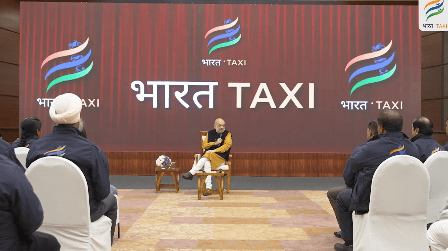
New Delhi, February 23, 2026 — Union Home Minister and Minister of Cooperation Amit Shah on Monday interacted with the ‘Sarathis’ of Bharat Taxi in the national capital, positioning the newly launched platform as a large-scale cooperative intervention in India’s urban mobility sector.
The interaction focused on ownership, profit-sharing, transparency, and welfare mechanisms for drivers—referred to as ‘Sarathis’—under the Bharat Taxi framework. The initiative has been structured as a cooperative model aimed at ensuring that drivers retain both operational control and financial stake in the enterprise.
Cooperative Ownership Model at the Core
Addressing the gathering, Shah emphasized that those who labour should receive the profits. He stated that the objective of Bharat Taxi is to make taxi owners prosperous, asserting that the ‘Sarathi’ is the real owner of the platform.
According to the Minister, Bharat Taxi has been formed by bringing together five major cooperatives in the country. Drivers who wish to become partners can acquire ownership rights by purchasing shares worth ₹500. He added that certain seats on the Board of Directors will be reserved for Sarathis once elections are conducted, allowing them to directly represent driver interests in governance decisions.
The Minister clarified that the objective of Bharat Taxi is not to generate large corporate profits but to strengthen driver welfare through a cooperative structure in which drivers are shareholders and policy participants.
Revenue-Sharing and Capital Structure
A key feature of the Bharat Taxi model is its revenue distribution framework. Shah explained that:
- 20% of total earnings will be deposited into Bharat Taxi’s account as the Sarathis’ capital.
- 80% of earnings will be returned directly to Sarathis based on kilometres travelled.
During the first three years, the focus will remain on expansion across urban centres. Post-expansion, profit-sharing will follow a similar 20:80 structure, with the majority of returns going back to driver-owners.
Shah stated that within three years, Bharat Taxi aims to establish its presence in every municipal corporation across India.
Financial Support Through Cooperative Banking
In a significant policy signal, the Minister said Bharat Taxi will facilitate loans for Sarathis through cooperative banks by mortgaging their taxis. This approach aligns the initiative with India’s broader cooperative banking ecosystem and aims to improve access to institutional finance for drivers.
The move could potentially reduce dependency on private financiers and high-interest lending arrangements that are common in the informal transport sector.
Pricing Framework and Transparency Commitments
Shah underlined that Bharat Taxi will operate on a baseline kilometre rate determined by minimum economic viability for drivers. The base rate will be calculated by combining:
- Vehicle cost,
- Fuel consumption,
- Minimum profit margin.
He said the service will not operate below this rate, positioning it as a welfare-oriented alternative to existing app-based aggregators.
The Minister also stressed transparency, stating that all relevant information will be communicated to Sarathis through notifications, with the goal of making Bharat Taxi “the world’s most transparent cab service.” A dedicated grievance redressal window will be available on the website, allowing Sarathis to log in via mobile number and submit concerns for policy review.
Focus on Women Drivers: ‘Sarathi Didi’
Shah announced the introduction of a ‘Sarathi Didi’ feature within the Bharat Taxi app. The provision is designed to:
- Encourage women’s participation as drivers,
- Enhance safety for female passengers and Sarathis,
- Automatically prioritize women drivers for solo female passengers.
The initiative seeks to combine economic empowerment with gender-sensitive service design.
Continuous Dialogue and Sectoral Reform
The Minister framed Bharat Taxi as part of a broader cooperative movement, stating that systemic reform in the taxi sector requires a structured and welfare-driven approach. He remarked that existing companies do not prioritize driver welfare, whereas Bharat Taxi aims to balance customer satisfaction with Sarathi empowerment.
Shah said continuous engagement with Sarathis will be maintained through online platforms, physical meetings, and call centres. He also encouraged drivers to adopt the term ‘Sarathi’ rather than ‘driver’, calling it a matter of dignity and social perception.
Policy Implications for India’s Gig and Mobility Economy
The Bharat Taxi initiative enters a competitive ride-hailing ecosystem currently dominated by private aggregators. By embedding cooperative ownership, profit-sharing, and governance participation, the model introduces a structural alternative within India’s gig economy.
If successfully scaled across municipal corporations as announced, Bharat Taxi could reshape conversations around:
- Platform cooperativism in India,
- Driver equity and income security,
- Cooperative-led digital enterprises,
- Gender-inclusive mobility models.
The coming years will determine whether the cooperative approach can sustain operational efficiency while delivering welfare outcomes at scale.
For India’s cooperative sector, however, the launch signals an expansion from traditional domains such as dairy and agriculture into app-based urban services—potentially marking a new phase in cooperative-led economic participation. Earlier, Bharat Taxi App crossed the milestone of over one lakh registered users on its newly launched consumer mobile application.
