



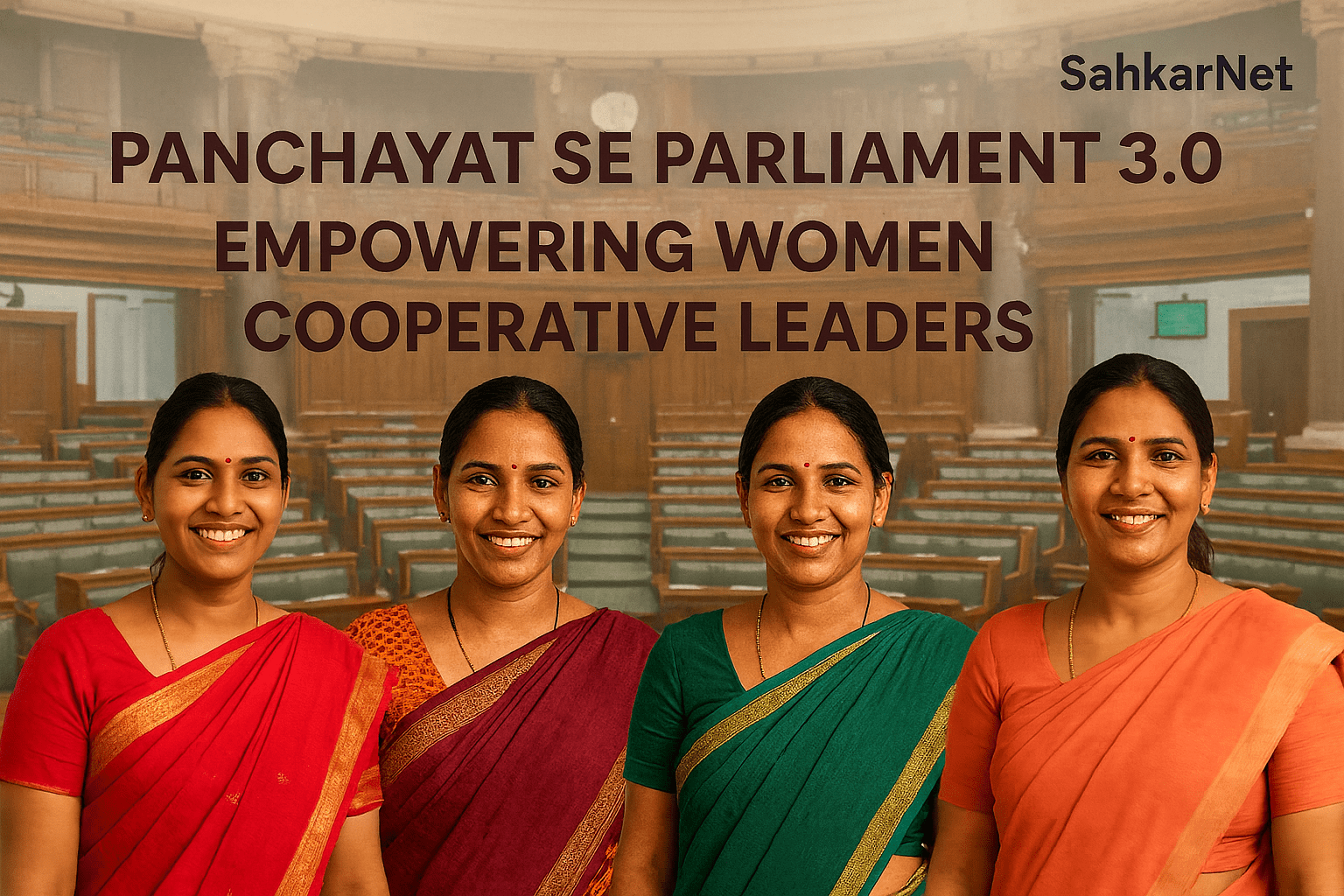
New Delhi — The third edition of Panchayat Se Parliament (3.0) — slated for early January 2026 — reframes a familiar outreach exercise into an explicitly gender-focused cooperative empowerment drive, bringing elected women leaders from Primary Agricultural Credit Societies (PACS), dairy, multi-purpose and other cooperatives to the national stage.
The programme is being organised by the National Commission for Women (NCW) in collaboration with the Ministry of Cooperation as part of celebrations around 2025 being the International Year of Cooperatives and the Government of India’s emphasis on strengthening the cooperative movement under the National Cooperative Policy 2025.
Roots and evolution
The initiative traces back to Panchayat Se Parliament 1.0 (January 2024), which introduced the concept of bringing grassroots elected representatives to interact with Parliamentarians and policy experts; a second edition Panchayat Se Parliament 2.0 followed in January 2025 with expanded workshops and guided tours of Parliament to familiarise local leaders with constitutional and legislative processes. These earlier editions emphasised capacity building for elected women sarpanches and panchayat leaders — a template 3.0 now adapts to a cooperative context.
Objectives and what’s new in Panchayat Se Parliament 3.0
As per sources, about 500 participants — predominantly elected women representatives (EWRs) from across cooperative domains — will attend the event being planned in the first week of January, 2026.
The objectives of the event are pragmatic: deepen cooperative governance literacy, link primary cooperatives with national schemes, and fast-track representation and access to finance and markets for women-led cooperative units. The event is aligned with the Government’s National Cooperative Policy 2025, which prioritizes legal reform, digitalization and greater inclusion of women and youth in cooperative governance.
Ministry of Cooperation’s role and policy signals
Since its inception, the Ministry of Cooperation has positioned itself as the central nodal agency to mainstream cooperatives into India’s development architecture — from a national cooperative database to targeted programmes under the National Cooperative Policy. By underwriting logistics and nominations for Panchayat Se Parliament 3.0, the Ministry is signalling an operational push to convert policy ambitions into human-capacity outcomes at the grassroots.
Amit Shah’s vision
Union Home Minister and Minister of Cooperation Amit Shah has publicly framed cooperatives as instruments of rural prosperity and women’s economic agency, directing institutional resources — including significant allocations via agencies like NCDC — towards dairy, fisheries and women cooperatives. The minister’s approach combines institution-building (new national-level societies), targeted credit flows and training to ensure elected women cooperative leaders not only participate but lead cooperative revival at the local level.
Overall, Panchayat Se Parliament 3.0 marks a strategic milestone in India’s cooperative reform journey by placing elected women cooperative leaders at the centre of national policy conversations. Anchored in the International Year of Cooperatives 2025 and the National Cooperative Policy 2025, the programme reflects the Ministry of Cooperation’s broader mission to build stronger, more inclusive cooperative institutions.
