



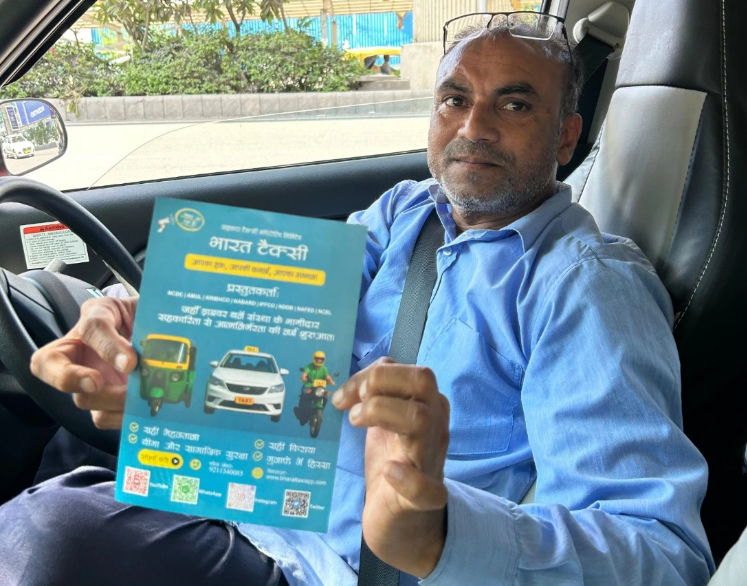
New Delhi —The Sahkar Taxi Cooperative today officially commenced the soft launch of its ride-hailing app, Bharat Taxi, in Delhi and Gujarat, marking a key moment for India’s urban mobility landscape. The new service, run on a cooperative model, started beta consumer trials, in what the cooperative describes as the start of a “people-owned” alternative to traditional cab aggregators.
With over 51,000 drivers — including cars, autos, and bikes — already registered across Delhi and Gujarat’s Saurashtra region, the cooperative is being promoted as the world’s first national mobility cooperative owned and run by drivers. The cooperative-led platform aims to offer an affordable, transparent and driver-centric mobility alternative, positioning itself as a strong challenger to existing ride-hailing players such as Ola, Uber and Rapido.
The Bharat Taxi mobile application has been released on the Google Play Store for public trials and user feedback, the cooperative announced. An iOS version of the app is also in the pipeline and will be launched soon to support wider adoption of the cooperative-led mobility platform.
Earlier, Union Minister for Cooperation Amit Shah had outlined plans to introduce a cooperative-led taxi-hailing platform that would allow seamless registration of two-wheelers, auto-rickshaws, taxis and four-wheelers on a single integrated system, strengthening the cooperative sector’s role in India’s mobility ecosystem.
What Sets Bharat Taxi Apart: Driver Ownership, Transparent Pricing & Integration
Driver-Owned Cooperative Model
Unlike conventional ride-hailing companies, the Sahkar Taxi Cooperative gives drivers co-ownership: drivers become members of the cooperative, hold shares, and — after a specified period — gain representation on the board, entitlement to dividends, and a share in profits.
Promoters: According to the cooperative’s founding framework under the Multi-State Co-operative Societies Act, Sahkar Taxi is backed by eight major cooperatives — including reputed entities such as National Cooperative Development Corporation (NCDC), Indian Farmers Fertiliser Cooperative (IFFCO), and National Bank for Agriculture and Rural Development (NABARD) — and was set up with an authorised capital of ₹300 crore.
Transparent Fares & No Surge Pricing
Under this cooperative model, drivers receive the full fare paid by customers — no commission deductions, no opaque algorithms, and no surge pricing — aiming to restore fairness to both drivers and passengers.
For commuters, this promises stable, predictable fares — a departure from the dynamic pricing models of many private aggregators.
Seamless Multi-Modal Integration
One of the distinguishing features of Bharat Taxi is its integration with transit services such as the Delhi Metro. This means users can book rides and combine different modes of transport — for instance, a Metro trip followed by a cab ride — within the same app, offering convenience and flexibility for urban commuter
Safety & Institutional Collaboration
For the soft launch, the cooperative has also announced a tie-up with Delhi Police to ensure safety for both riders and drivers, especially in the early rollout phase.
The service reportedly begins from major transit hubs — including the airport, ISBTs, and railway stations — with on-ground booking booths to support customer service during the pilot phase.
Pilot Phase & Roadmap Ahead
According to the cooperative, the current soft launch is a beta phase aimed at collecting user feedback to fine-tune operations.
Earlier statements from Sahkar Taxi had projected a gradual scale-up: starting with a few hundred drivers and expanding to thousands across multiple states.
The cooperative envisions establishing call centres and support teams even in Tier-II and Tier-III cities — a significant departure from typical app-based services that centralize operations in metro areas.
What It Means for Delhi’s Mobility — and What to Watch For
- For drivers: Bharat Taxi offers ownership, profit-sharing, and a cooperative governance structure — potentially a major shift away from the gig-economy model of current aggregators.
- For commuters: The promise of transparent, stable fares without surge pricing — plus integration with Metro — could make daily commuting smoother and more affordable.
- For the transport ecosystem: If the pilot succeeds, this cooperative model could challenge existing private players, especially in congested urban centres, and set a precedent for equitable, socially conscious ride-hailing.
However, the success will depend on factors such as app performance, ride-matching efficiency, driver availability, and user adoption during the soft-launch phase.
