



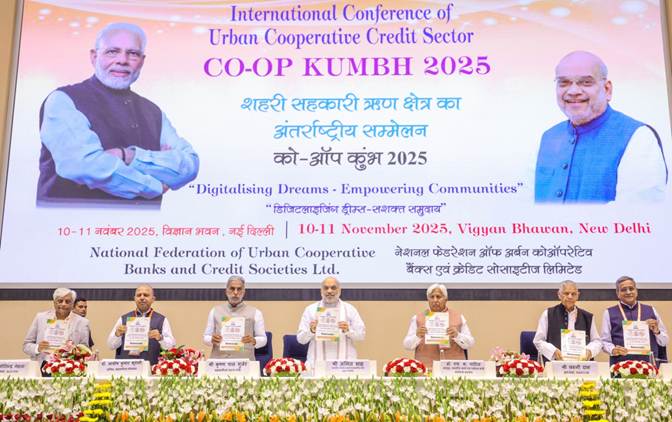
Union Home Minister and Minister of Cooperation Amit Shah today addressed the international conference on the urban cooperative credit sector, “Co-Op Kumbh 2025,” in New Delhi, underscoring the government’s commitment to modernizing India’s cooperative ecosystem.
The ‘Delhi Declaration 2025’
Organized by NAFCUB, the event marks a significant milestone in the International Year of Cooperatives, with the adoption of the ‘Delhi Declaration 2025’ — a strategic roadmap for expanding Urban Cooperative Banks (UCBs) across India.
Highlighting the sector’s rapid transformation, Shah announced that within the next five years, an Urban Cooperative Bank will be established in every city with a population exceeding two lakh. The initiative aims to strengthen financial inclusion for small traders, entrepreneurs, and youth, who form the backbone of India’s urban economy.
Two new digital platforms launched
Two new digital platforms — ‘Sahkar Digi-Pay’ and ‘Sahkar Digi-Loan’ — were launched under the Umbrella Organization for Urban Cooperative Banks. Shah described them as symbols of the sector’s entry into the digital revolution, enabling even the smallest cooperative banks to offer online payment and credit services.
“The Modi government has brought fundamental policy reforms to make cooperatives more modern, transparent, and people-centric,” Shah said, adding that Non-Performing Assets (NPA) in UCBs have been reduced from 2.8% to just 0.6% in two years — a sign of growing financial discipline and confidence in the sector.
Generation Sahakar
Reiterating the Ministry’s focus on ‘Generation Sahakar’, Shah announced the establishment of Tribhuvan Sahkari University, dedicated to capacity building, research, and skill development in cooperative management. He emphasized that cooperatives must evolve into multi-sector institutions supporting women, self-help groups, and the underprivileged.
Global success of AMUL and IFFCO
In a strong endorsement of India’s cooperative model, Shah highlighted the global success of Amul and IFFCO, ranked first and second worldwide by the International Cooperative Alliance.
Amul, the powerhouse of India’s White Revolution, operates through its 3.6 million farmer members, 18,000 village societies, and 18 district unions, collectively procuring 30 million litres of milk daily. In 2024–25, Amul’s turnover surpassed ₹90,000 crore, driven by its member base consisting of over 65% women — who have sustained this massive cooperative through their small yet consistent individual contributions.
IFFCO, ranked as the world’s second-largest cooperative organization, achieved a turnover of ₹41,000 crore and a profit of ₹3,000 crore. With a network of 35,000 member cooperative societies—mainly PACS and marketing societies—it represents over 5 crore farmers nationwide.
He said that a key pillar of India’s Green Revolution, IFFCO produces 93 lakh metric tonnes of urea and DAP annually, while its nano urea and nano DAP are exported to 65 countries, including Brazil, Oman, the U.S., and Jordan.
“The achievements of Amul and IFFCO prove that the cooperative model remains not only relevant but vital for India’s inclusive growth,” Shah affirmed. With the Delhi Declaration 2025, the Ministry of Cooperation envisions a digitally empowered, transparent, and sustainable cooperative banking network as a key pillar of Atmanirbhar Bharat.
Last year, the Cooperation Minister Amit Shah had launched the National Urban Cooperative Finance and Development Corporation (NUCFDC)
