



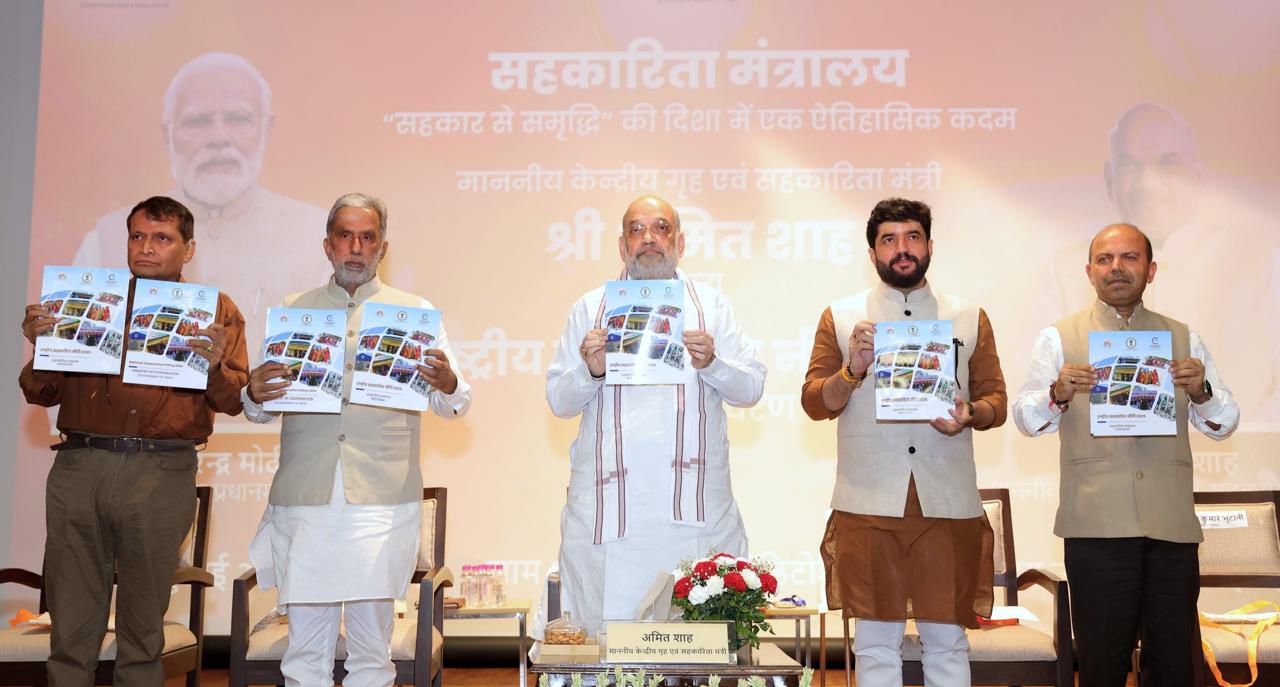
Union Home Minister and Minister of Cooperation, Amit Shah, formally unveiled the National Cooperative Policy – 2025 yesterday in New Delhi, marking a major milestone for the Indian cooperative sector. The event was attended by Union Minister of State for Cooperation Shri Krishan Pal Gurjar, Cooperation Secretary Dr. Ashish Kumar Bhutani, former Union Minister and chairman of the policy drafting committee Shri Suresh Prabhu, and several other dignitaries.
Consultative and Inclusive Approach
Shah acknowledged the efforts of the 48-member committee led by Shri Suresh Prabhu, which held regional workshops and engaged with stakeholders including cooperative leaders, experts, ministries, and institutions such as RBI and NABARD. The committee received approximately 750 suggestions, held 17 meetings, and finalized a policy aimed at revitalizing the sector.
Vision Rooted in ‘Sahkar Se Samriddhi’
The new policy builds on Prime Minister Narendra Modi’s vision of “Prosperity through Cooperation”, and aligns with India’s ambition to become the world’s third-largest economy by 2027. Shri Shah stressed that inclusive development of India’s 1.4 billion citizens is key to achieving this goal and that the cooperative model uniquely supports collective progress, especially in rural areas.
Empowering Grassroots and Broadening Participation
The policy emphasizes expanding cooperative presence at the grassroots level, with plans to establish at least one cooperative unit in every village panchayat. These units may include PACS, dairy, fisheries, multipurpose societies, or other forms of cooperatives. The government aims to increase the number of cooperative societies by 30% (currently at 8.3 lakh) and bring 50 crore people into active participation in the cooperative movement.
To enhance efficiency and transparency, a cluster-based monitoring system will be established. A roadmap is also in place for creating five model cooperative villages per tehsil, starting with an initiative launched in Gandhinagar in partnership with NABARD.
Pillars and Goals of the Policy
The policy is structured around six core pillars:
• Strengthening foundations
• Promoting vibrancy
• Preparing cooperatives for the future
• Enhancing inclusivity and expanding reach
• Expanding into new sectors
• Engaging the younger generation
It aims to triple the cooperative sector’s contribution to India’s GDP by 2034 and foster member-centric, technology-enabled, and self-reliant cooperative units.
Sectoral Expansion and Economic Integration
Shri Shah announced that cooperatives will be enabled to enter emerging sectors such as tourism, taxi services, insurance, and green energy. Notably, a “Sahkar Taxi” scheme will be launched by the end of the year, ensuring that all profits go directly to drivers. The integration of cooperatives with government schemes like PM Jan Aushadhi, Surya Ghar Yojana, and Har Ghar Jal is already underway.
Additionally, over 4,000 PACS have been approved to operate medicine centers, while others are moving into fuel distribution and LPG services. White Revolution 2.0, focusing on women’s participation, is expected to become a cornerstone of rural development.
Strengthening Institutions and Future Readiness
To support professional manpower needs, the foundation of Tribhuvan Sahkari University has been laid. Scheduled cooperative banks will be supported to ensure they operate on par with commercial banks. Technology-driven, transparent systems are being introduced in PACS and will be expanded across all cooperative types.
Shri Shah highlighted the creation of three new multi-state cooperative societies—for exports, seed production, and branding of organic products—to enhance India’s global cooperative footprint.
Implementation and Monitoring
A total of 83 intervention points have been identified for policy implementation, with work completed on 58 and 3 fully implemented. Two areas will require continuous implementation, and the rest will be addressed soon. Legal provisions will be reviewed every 10 years to ensure the policy remains relevant.
Inclusive and Member-Centric Framework
The policy is guided by the principle of member welfare, focusing on enhancing the role of women, youth, Dalits, and tribals in economic development. It aims to establish a cooperative sector where the youth consider it a viable and respected career choice. Terming the policy visionary, practical, and outcome-oriented, Amit Shah emphasized that it positions the cooperative sector to become a vital contributor to India’s journey toward a Viksit Bharat by 2047.
