



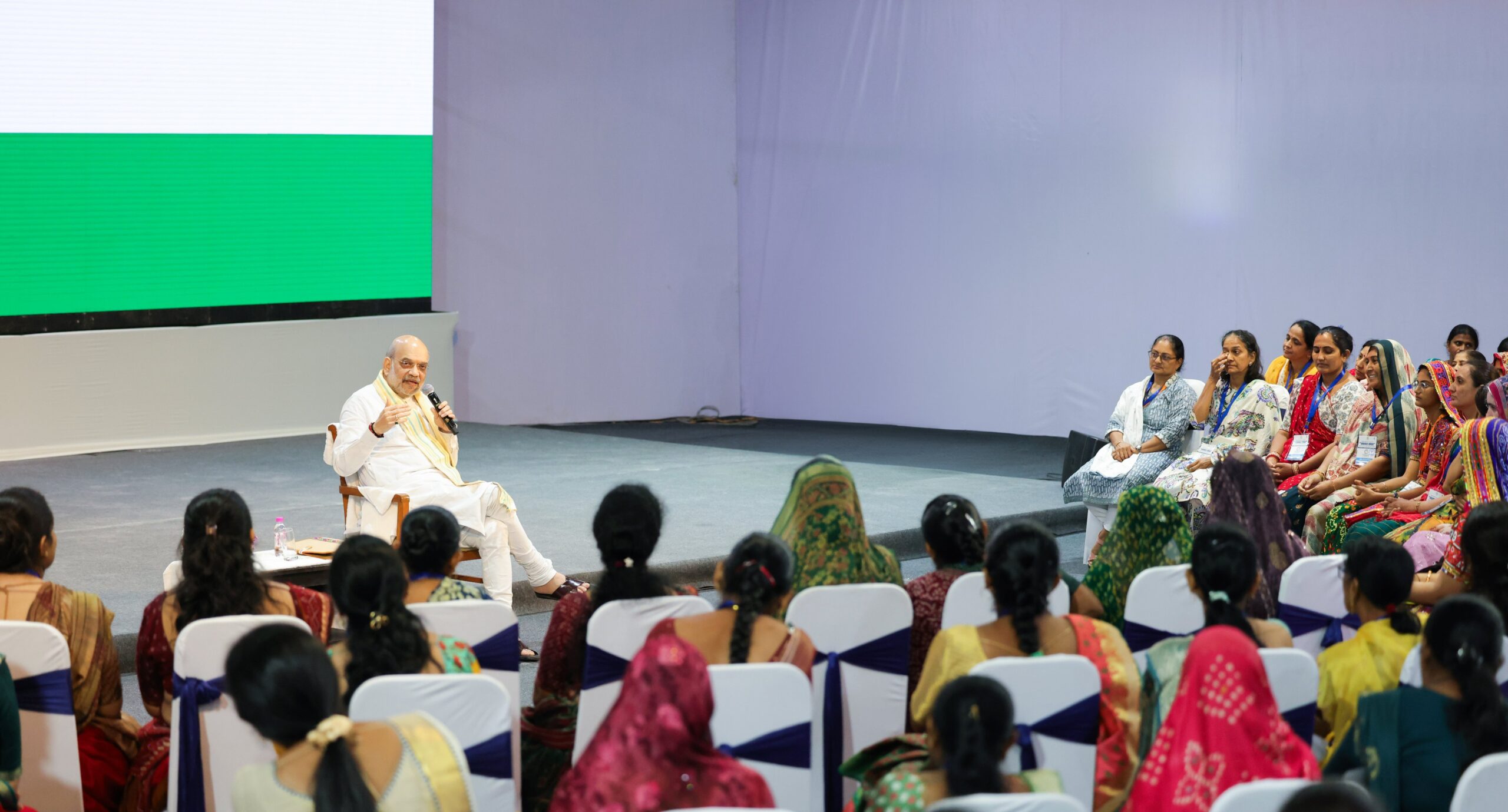
As part of the ongoing celebrations for the International Year of Cooperatives, Union Home Minister and Minister of Cooperation Shri Amit Shah engaged in a meaningful dialogue titled ‘Sahkar Samvad’ with women cooperative workers from Gujarat, Madhya Pradesh, and Rajasthan. The event, held in Ahmedabad, showcased the government’s renewed commitment to empowering rural communities, especially women, through cooperative reforms and grassroots dialogue.
The interaction brought together hundreds of women who are active participants in various cooperative initiatives, providing a platform to share experiences, gather feedback, and outline a clear roadmap for the future of India’s cooperative sector.
Honouring the Legacy of Tribhuvandas Patel
At the heart of the conversation was a tribute to Tribhuvandas Patel, the pioneer of India’s milk cooperative movement. Shri Shah highlighted that the recently announced “Tribhuvan” Sahkari University in Anand is a direct extension of Tribhuvandas Ji’s vision to professionally train youth in cooperative leadership and management.
“Today, 36 lakh women in Gujarat are generating over ₹80,000 crore in cooperative-based income. This success is a direct outcome of the foundations laid by Tribhuvandas Ji,” Shah remarked. He emphasized that while some questioned the decision to name the university after him, the choice reflects the legacy of a man who worked quietly but transformed millions of lives.
Shah also called upon all milk-producing mandis and cooperative institutions to display Tribhuvandas Ji’s photograph to educate future generations about his contribution.
Innovations in Dairy Cooperatives and Animal Care
Shri Shah announced that the Ministry of Cooperation is working on a comprehensive framework for the management of animal health, feed, and dung in cooperative dairies. Plans are underway to utilize cow dung for organic manure and biogas generation, creating an additional income stream for dairy farmers.
“Soon, a cooperative village will not just produce milk but will also process cow dung, manage animal health, and carry out vaccinations — all under one roof,” Shah said, adding that these plans will take final shape within the next six months.
Strengthening PACS for Rural India
With reforms in Primary Agricultural Credit Societies (PACS) gaining momentum, Shri Shah emphasized the importance of expanding PACS beyond credit. He noted that PACS are now connected with services like Common Service Centres (CSC), Micro ATMs, Jan Aushadhi Kendras, and Har Ghar Nal schemes, among others.
Empowering Farmers through Digital Access and Natural Farming
The Union Minister encouraged farmers growing maize and pulses to register on the NCCF app, which allows them to sell crops at Minimum Support Prices (MSP) through government procurement channels or in the open market, depending on price benefits.
Shri Shah strongly advocated natural farming, describing it as a scientific, health-focused, and eco-friendly practice. Citing his own farm experience, he revealed that his yield increased by 1.5 times without using synthetic fertilizers. “When you let the earthworm do the job of urea and DAP, your soil becomes healthier, water use goes down, and you stay away from medicines,” he explained.
The Ministry has already launched a national-level cooperative to procure grains produced through natural farming, alongside an export-focused cooperative that ensures profits go directly to farmers’ bank accounts.
Camel Milk, Conservation, and Cooperative Value Chains
In a unique move, Shri Shah revealed that research is underway on the medicinal properties of camel milk, with upcoming schemes from the Rajasthan and Gujarat governments aimed at boosting camel rearers’ incomes and aiding in camel breed conservation.
“Once the value of camel milk rises through its medicinal uses, rearing camels will become economically viable again,” he said.
A Cooperative Model for Empowered India
Shah announced plans to organize 10 more ‘Chaupals’ across three states each, where direct dialogues like Sahkar Samvad will help shape policy based on ground-level realities and local wisdom.
The Sahkar Samvad served not just as a platform for sharing government initiatives but as a reminder that India’s cooperative movement is deeply personal, people-driven, and ready to meet the challenges of a changing world. From dairy to natural farming, PACS to digital access, and camel milk to organic manure — the future of cooperation lies in innovation, inclusion, and integrity.
