



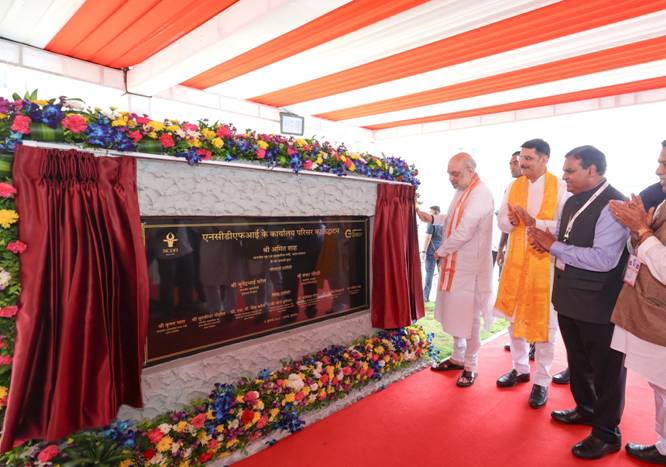
In a powerful display of progress and promise, Union Home Minister and Minister of Cooperation Shri Amit Shah addressed a landmark event in Anand to mark four years of the Ministry of Cooperation and commemorate the 150th birth anniversary year of Sardar Vallabhbhai Patel. The celebration also witnessed the launch of several significant cooperative sector initiatives, reinforcing Anand’s role as the beating heart of India’s cooperative movement.
Key Highlights from the Day
- Launch of Sardar Patel Cooperative Dairy Federation Ltd., a new multi-state cooperative.
- Virtual inauguration of major Amul plant expansions: Cheese Plant at Kheda and Chocolate Plant at Mogar.
- Inauguration of Maniben Patel Bhawan, new NCDFI office at NDDB complex.
- Dedication of the Ready-to-Use Culture (RUC) Plant developed by NDDB.
- Foundation stone laid for a new NDDB headquarters building in Anand.
These initiatives underscore the government’s commitment to strengthening India’s cooperative framework at the grassroots and national levels.
“The Ministry has breathed new life into more than 8.4 lakh cooperative societies touching 31 crore people across the country,” Shah said while addressing the gathering. From dairy to banking, sugar to digital payments, he emphasized that cooperatives are fast becoming the cornerstone of India’s inclusive economic development.
The 5 Pillars of Cooperative Transformation
Highlighting the Ministry’s achievements, Shri Shah said that over 60 reformative initiatives have been undertaken based on five strategic pillars:
- People – Making the common citizen the true beneficiary of cooperative schemes.
- PACS – Strengthening Primary Agricultural Credit Societies nationwide.
- Platform – Enabling cooperatives through digital transformation and unified platforms.
- Policy – Ensuring that cooperative policies benefit members directly, including in non-traditional sectors like salt production.
- Prosperity – Empowering lakhs of women and small producers, such as 56 lakh sisters across India generating a turnover of over ₹80,000 crore — a figure expected to cross ₹1 lakh crore next year.
“This prosperity is not limited to a few individuals, but is meant for the entire society — the farmers, workers, and the underprivileged,” Shah emphasized.
Strengthening India’s Dairy and Cooperative Infrastructure
One of the event’s focal points was the launch of the Sardar Patel Cooperative Dairy Federation, which aims to create a circular and sustainable dairy economy by ensuring fair milk procurement, organized markets, input services, and equitable pricing — modeled after the success of Amul.
Shri Shah also highlighted the pioneering efforts of the Kutch District Salt Cooperative Society, describing it as a new wave in cooperative innovation, set to replicate Amul’s success among salt producers.
Other key inaugurations included:
- Amul Chocolate Plant Expansion: Doubling production capacity from 30 to 60 tonnes per day.
- Dr. Verghese Kurien Cheese Plant in Khatraj: ₹260 crore investment featuring smart warehousing, mozzarella cheese production, whey-based drinks, and more.
- NDDB’s Ready-to-Use Culture (RUC) Plant: Built at a cost of ₹45 crore, a key step in modernizing India’s dairy fermentation technology.
- NCDFI Headquarters (Maniben Patel Bhawan): A ₹32 crore state-of-the-art office.
- Foundation Stone for New NDDB HQ Building.
Looking Ahead: A National Cooperative Ecosystem
The Minister reiterated the government’s vision to:
- Establish 2 lakh new PACS across India.
- Set up three national cooperatives for grain procurement and marketing.
- Create three national-level dairy cooperatives.
- Expand cooperative presence in areas such as insurance and transportation.
- Build a strong pipeline of trained cooperative professionals through the newly established Tribhuvan Sahkari University.
He also emphasized that transparency, technology adoption, and member-centricity will be crucial to the success and sustainability of cooperative institutions.
Cooperation as a Cultural Movement
Shri Shah called upon cooperative leaders across India to embed three essential values into their operations:
- Transparency – “Without it, the spirit of cooperation cannot survive.”
- Technology Acceptance – “Survival and growth now depend on innovation.”
- Member-Centricity – “Institutions must put their members at the heart of every decision.”
“These are not just managerial principles,” he said, “but cultural commitments we must spread to every district in the country.”
A New Era for Cooperatives
The event in Anand was not just a celebration of past achievements but a blueprint for the future of India’s cooperative movement. With new institutions, robust infrastructure, and a clearly defined vision, the Ministry of Cooperation is poised to lead a cooperative revolution grounded in economic equity, empowerment, and community ownership.
As the nation observes the International Year of Cooperatives, the message is clear: India’s cooperative movement is not only alive but evolving — ready to empower the next generation of farmers, workers, and entrepreneurs.
