



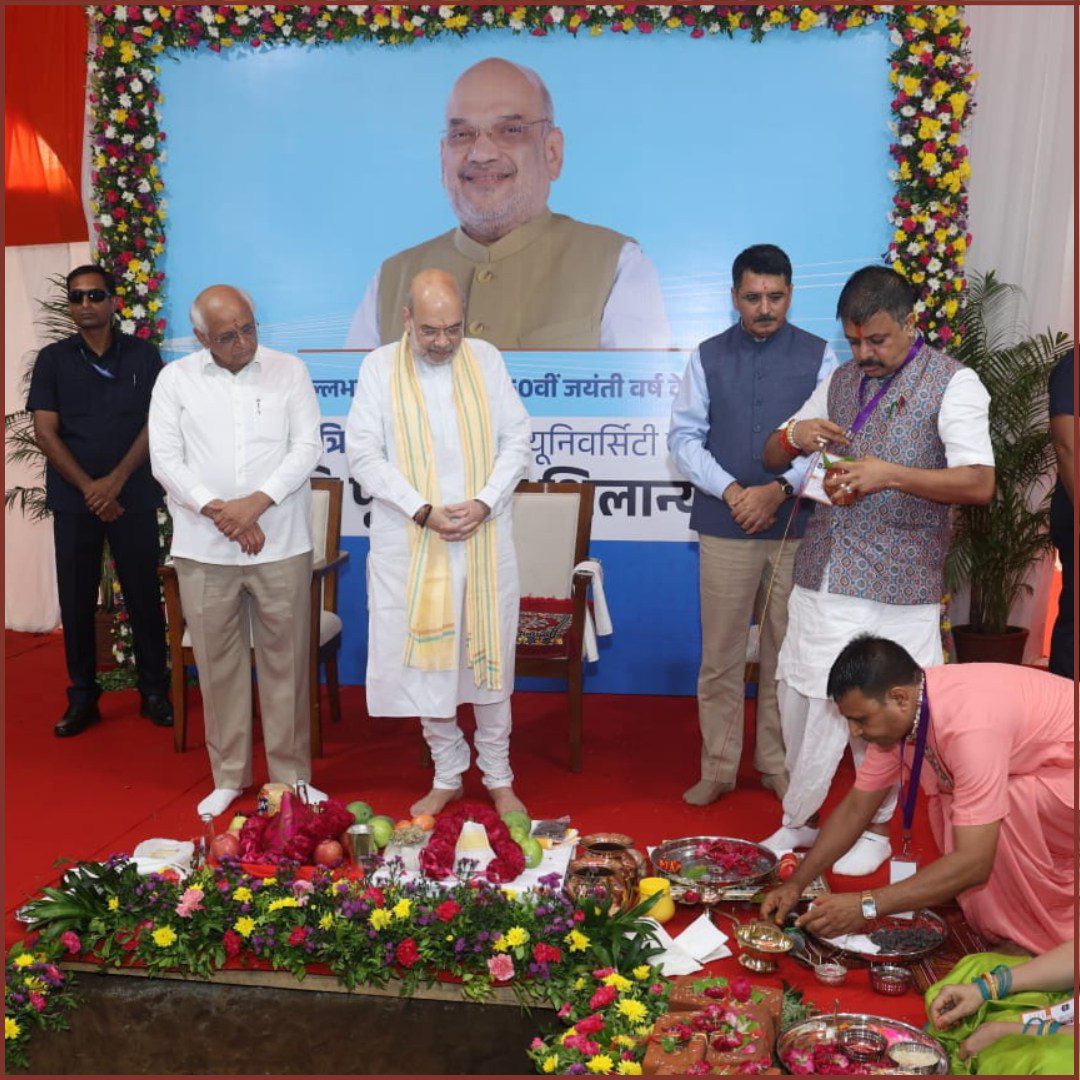
In a historic moment for India’s cooperative sector, Union Home Minister and Minister of Cooperation Shri Amit Shah today performed the Bhoomi Poojan of the country’s first cooperative university — “Tribhuvan” Sahkari University — in the cooperative capital of India, Anand, Gujarat.
The ceremony was graced by Gujarat Chief Minister Shri Bhupendrabhai Patel, Union Ministers of State for Cooperation Shri Krishan Pal Gurjar and Shri Muralidhar Mohol, and Secretary of the Ministry of Cooperation, Dr. Ashish Kumar Bhutani, among other dignitaries.
A Vision Realized for the Cooperative Sector
Speaking on the occasion, Shri Amit Shah described the day as a historic one for India’s cooperative movement, calling it a true tribute to Tribhuvan Das Patel, the legendary figure who pioneered cooperative dairy in India under the guidance of Sardar Vallabhbhai Patel.
He emphasized that under the leadership of Prime Minister Narendra Modi, the cooperative movement in India has received unprecedented attention and reform. “Since the formation of the Ministry of Cooperation four years ago, 60 major initiatives have been taken to make the sector more democratic, transparent, and inclusive,” Shah said.
A University to Empower Millions
The proposed university, named after Tribhuvan Das Kishibhai Patel, will span 125 acres and be built with an investment of Rs 500 crore. It aims to fill the long-standing gaps in training, policy research, and innovation in the cooperative ecosystem.
“Earlier, training for cooperative employees was informal and post-recruitment. Now, only those with structured training from this university will be eligible for employment,” said Shah. This move is expected to eliminate nepotism and instill professionalism in the sector.
The university will offer education in areas such as cooperative management, accounting, marketing, data analysis, policy-making, and leadership, while also instilling the core values of equity and inclusiveness that form the backbone of the cooperative spirit.
Supporting a Growing Ecosystem
India’s cooperative sector is massive, with over 30 crore members, 40 lakh workers, and 80 lakh board members. With the government’s plan to form 2 lakh new Primary Agricultural Credit Societies (PACS) — 60,000 of which will be operational by the end of 2025 — the need for trained manpower is more critical than ever.
“Just the PACS network will require around 17 lakh trained employees,” Shah noted, adding that this university will be the backbone in supplying the required human resources and leadership.
Beyond education, “Tribhuvan” Sahkari University will also:
- Conduct cooperative policy research
- Design 5-, 10-, and 25-year cooperative development strategies
- Offer training to future cooperative leaders
- Standardize curriculum and training modules across India
A National Platform for Cooperative Innovation
The university is expected to become a hub for innovation, education, and training in the cooperative domain, linking practical ground-level work with academic research and policy implementation. Shri Shah also called on cooperative experts from across India to contribute to the institution and help shape its curriculum and programs.
He highlighted that the CBSE has already included cooperatives as a subject in classes 9 to 12, and urged the Gujarat government to adopt similar measures at the state level to foster awareness from a young age.
Future Plans and Expansions
With plans to create cooperative taxi services and even a cooperative insurance company, the university will be pivotal in producing professionals and leaders across multiple cooperative verticals. “The goal is to transform the economic model of cooperation into a mass movement,” Shah said.
Earlier SahkarNet had published article on Cooperative University. You can read it here ‘IRMA to Coop University: The How and What?’
